Last Updated: November 22, 2026
Quick Summary
The cost of fire safety inspections for businesses is the sum of several separate charges: the inspection visit itself, testing of each fire safety asset on site, any maintenance or repairs uncovered, and the documentation that proves compliance. Most quotes that surprise property managers cover only the first of those four.
- Asset count is the biggest single driver of inspection price, ahead of floor area and system complexity.
- Extinguishers and hose reels sit on a six-monthly cycle, so 40 extinguishers means 80 unit services annually.
- A complete fire compliance cost has five layers, including call-out fees and certification documentation.
- The annual fire safety statement is a separate cost from routine servicing and cannot be signed off on unresolved defects.
- Ask each contractor which cost layers their quote covers so comparisons are genuine.
Table of Contents
- What Drives the Cost of Fire Safety Inspections for Businesses
- Building Size, Complexity and Fire Safety Asset Count
- Pricing by Inspection Type: From Extinguishers to Sprinkler Systems
- Fire Safety Inspection Checklist for Businesses
- Using a Fire Compliance Cost Calculator
- Fire Safety Inspection Quote Comparison: What to Check Before You Sign
- Annual Fire Safety Statement Cost and Why It Matters
- Book Your Six-Monthly Fire Safety Inspection
- Frequently Asked Questions
What Drives the Cost of Fire Safety Inspections for Businesses
The cost of fire safety inspections for businesses is not a single line item.
A quote that looks competitive on paper can rise once remedial work is added. The businesses that control their spend are the ones that understand what they are actually buying.
Below, we break down how fire safety inspections are priced in practice, what each fee covers, and the questions to ask before you sign.
Building Size, Complexity and Fire Safety Asset Count
Asset count is the biggest single driver of price. A small retail tenancy with four extinguishers and two exit signs is a fundamentally different job from a three-level building with a fire indicator panel, sprinkler system, hydrant network, and dozens of fire doors.
Three factors push a quote up:
- Floor area and number of levels. More space means more assets and longer travel time on site.
- System complexity. A sprinkler system or fire indicator panel takes far longer to test than an extinguisher.
- Site access. Restricted hours, occupied tenancies, and parking constraints all add labour time.
If you want to understand how building scale affects sprinkler-related costs specifically, our breakdown of commercial fire sprinkler system cost per square foot explains what drives pricing across system types.
Pricing by Inspection Type: From Extinguishers to Sprinkler Systems
Each asset type carries its own service frequency and testing routine. That frequency directly shapes your annual spend, but frequency alone does not tell you what you are paying for. The scope of work at each visit is what separates a cheap line item from a compliant one.
| Inspection type | Typical frequency | What the service involves | Main cost driver |
|---|---|---|---|
| Fire extinguishers | Six-monthly service | Visual check, pressure gauge, tag, seal, weight check; annual pressure test on some types | Number of units on site |
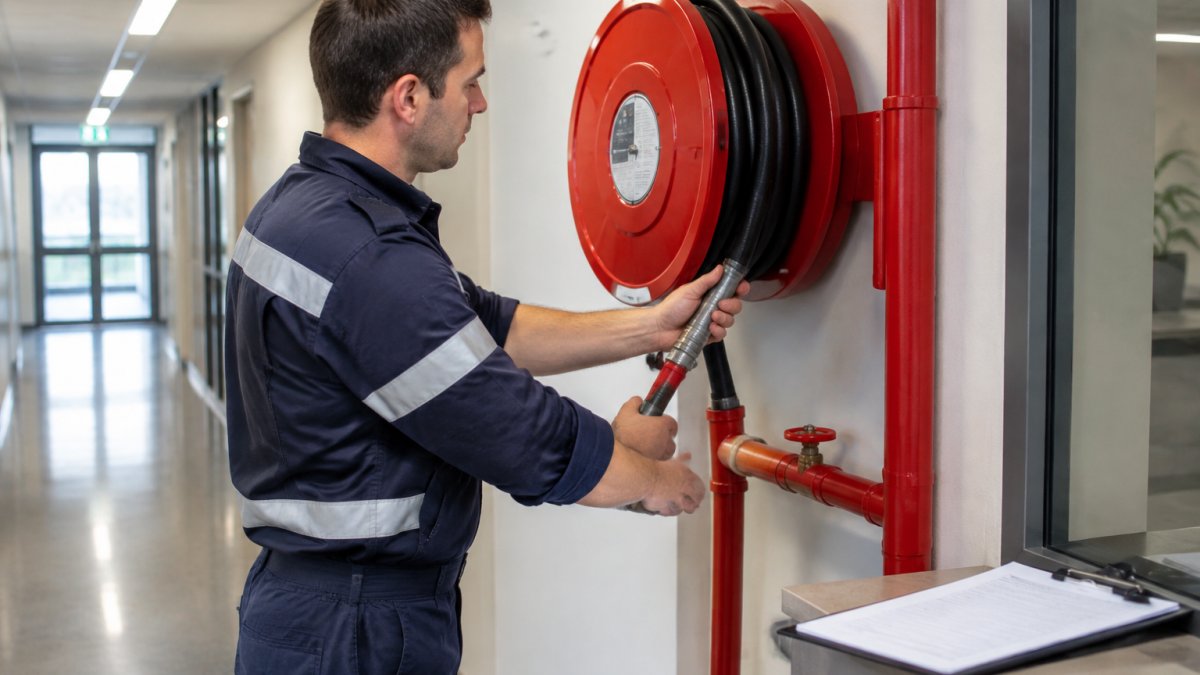
| Fire hose reels | Six-monthly service | Flow and pressure check, hose condition, nozzle and valve operation | Reel count and line condition |
| Smoke detection | Monthly and annual checks | Detector test at the panel, log entry, cleaning or replacement as needed | Detector count and panel type |
| Fire indicator panel | Monthly and annual | Fault log review, zone test, battery check, alarm verification | Panel complexity and zone count |
| Fire hydrants | Six-monthly and annual flow test | Valve operation, flow and pressure test, accessibility check | Hydrant count and access |
| Sprinkler systems | Monthly, quarterly, annual | Valve set inspection, alarm test, flow switch test, gauge check | Coverage area and valve sets |
| Fire doors | Annual | Close and latch test, hardware check, gap and seal inspection | Door count and hardware |
What each layer of the price covers
A quote for these asset types can include or exclude several separate layers. Knowing which layers are in the price is more useful than comparing headline figures.
- Inspection, the visual and functional check of the asset on the day.
- Testing, the operational test that confirms the asset performs as designed, such as a flow test or panel zone test.
- Maintenance, the minor adjustments and replacements that keep the asset compliant between major services.
- Certification, the report, logbook entry, or statement that documents the work for audit and AFSS purposes.
A quote that covers inspection only will look cheaper than one covering inspection, testing, maintenance, and certification. The difference is not the hourly rate; it is the scope.
How frequency compounds the annual cost
Extinguishers and hose reels sit on a six-monthly cycle, so they generate two service visits a year plus any annual testing. Panels and detectors typically combine monthly checks with an annual test. Sprinkler systems can attract monthly, quarterly, and annual routines depending on the system type and the building’s risk profile.
Because the cycles differ, the annual spend is not simply the sum of one visit per asset. It is the sum of every required visit across the year.
If you want to benchmark what recharge and service work should cost, our guide to fire extinguisher recharge costs sets out the pricing structure.
Watch out: a quote that prices only the six-monthly visit without stating the annual test or the certification deliverable will usually leave the AFSS and annual testing to be charged separately, which is where the budget gap appears.
Fire Safety Inspection Checklist for Businesses
A fire safety inspection checklist is the list of assets and conditions an inspector must verify on site. Knowing it in advance helps you spot whether a quote covers the full scope or only part of it.
A standard commercial checklist covers:
- Extinguishers charged, tagged, and unobstructed
- Hose reels free of leaks and correct pressure
- Smoke and heat detectors tested and logged
- Fire indicator panel faults cleared
- Exit and emergency lighting operational
- Fire doors closing and latching correctly
- Hydrants accessible and flow tested
- Evacuation diagrams current and displayed
If an item is missing from a quote, it will likely appear later as a variation. For a fuller equipment-by-equipment walkthrough, see what to check in a fire equipment inspection.
Using a Fire Compliance Cost Calculator
A fire compliance cost calculator is a tool that estimates your annual inspection spend from your asset register. It is only as good as the inputs you give it.
To get a realistic figure, gather:
- Your full asset list, including quantities of each item
- The required service frequency for each asset type
- Any known defects or outstanding remedial work
- Site access restrictions that affect labour time
Be cautious with online calculators that produce a single number without asking about asset counts. They tend to understate real costs because they exclude repairs and documentation.
Fire Safety Inspection Quote Comparison: What to Check Before You Sign
Two quotes for the same building can differ noticeably, and the gap is often about what is included. The most useful way to compare is to strip each quote back to the same itemised scope, then price the differences.
Separate the five cost layers
A complete fire compliance cost is made up of five distinct layers, and most quotes bundle or omit at least one:
- Inspection and testing labour, the time on site to test each asset.
- Consumables and minor parts, tags, batteries, replacement bulbs, seals.
- Maintenance and repairs, work needed to bring a faulty asset back to standard.
- Certification and documentation, service reports, logbooks, and the annual fire safety statement.
- Call-out and after-hours fees, attendance charges, travel, and penalty rates.
A low headline figure can mean some layers are excluded or priced separately. Ask each contractor to state which layers their quote covers so the comparison is genuine.
Quote comparison checklist
Use this checklist to compare quotes side by side. A quote that cannot answer every line is not comparable.
- Asset register attached, every extinguisher, hose reel, detector, panel, hydrant, sprinkler valve set, and fire door listed individually with quantities
- Service frequency stated, six-monthly, annual, and monthly cycles each priced, not just the first visit
- GST shown separately, confirm whether the figure is inclusive or exclusive of GST
- Call-out fee disclosed, flat attendance charge versus hourly, and whether it applies to scheduled visits
- After-hours and access costs, penalty rates for out-of-hours work, lift access, parking, and escort requirements
- Reporting deliverables named, what documents you receive and whether they suit an audit or AFSS lodgement
- Remedial work priced or flagged, whether defects are quoted on the spot or as a separate variation
- Licensing and insurance, contractor licence number and public liability cover stated on the quote
- Validity period, how long the pricing holds before it is re-quoted
Worked comparison: same building, two quotes
Consider a two-level retail building with 18 extinguishers, six hose reels, a fire indicator panel, 24 smoke detectors, and eight fire doors. One quote may show a single annual figure covering “fire equipment servicing”. Another may itemise the six-monthly extinguisher and hose reel service, the annual panel and detector test, the fire door inspection, and a separate line for the AFSS. Because the extinguisher line can conceal differences in service scope, compare fire extinguisher inspection services against the same equipment count and inspection interval before weighing the total quote.
Questions to ask before signing
- Which assets are included, and can I see the register?
- Are six-monthly and annual services both covered in this price?
- What is excluded, and how are exclusions priced if they arise?
- Do I receive a report after every visit, and does it support AFSS lodgement?
- What is the call-out fee, and does it apply to scheduled visits?
- Who holds the licence, and what is the public liability cover?
Before signing, it is worth knowing how to select a certified fire safety inspector and how to verify credentials independently.
Annual Fire Safety Statement Cost and Why It Matters
The annual fire safety statement is a separate cost from routine servicing. It is the formal document confirming that the essential safety measures in your building have been assessed and are performing as intended.
Two things drive its cost: the number of essential safety measures to be assessed, and whether any remedial work is needed before the statement can be issued. A statement cannot be signed off on the back of unresolved defects.
Our guide to annual fire safety statement compliance covers lodgement deadlines, AS 1851 requirements, and how to avoid penalties.
Book Your Six-Monthly Fire Safety Inspection
The most effective way to control the cost of fire safety inspections for businesses is to move from reactive call-outs to a scheduled maintenance program. Predictable cycles mean predictable budgets, and fewer emergency repairs.
Fyrepower provides fully insured, QBSA-licensed testing and maintenance across commercial, strata, and industrial properties.
Get in touch with us now! Visit the Fyrepower website for current prices or a quote.
Fire safety compliance punishes delay more than it punishes cost. If your last inspection report was vague, or your six-monthly cycle has slipped, that is the signal to act.
Frequently Asked Questions
How much does a fire safety inspection cost for a business?
Pricing depends on the number and type of fire safety assets, building size and service frequency. A single extinguisher service costs far less than a full annual inspection covering hydrants, sprinklers, fire doors and a fire indicator panel. Because Fyrepower does not publish fixed rates, request a site-specific quote that lists each asset, the AS 1851 service interval and any call-out fee. That way you can compare the total scope rather than a headline figure.
What is included in a commercial fire safety inspection?
A commercial inspection covers every essential safety measure on the premises: extinguishers, smoke detection, fire indicator panels, hydrants, sprinkler systems and fire doors. Each asset has its own inspection and testing routine at set intervals, such as six-monthly or annual. The report should record what was tested, the results and any defects. Ask for a checklist aligned to the fire safety inspection checklist for businesses before the technician arrives.
How can a business compare fire safety inspection quotes?
Line up quotes side by side and check what each one actually covers. Look for the number of assets, the service intervals, whether call-out fees and GST are included, and whether remedial work is quoted separately. A fire safety inspection quote comparison should also confirm licensing and insurance. Ask each provider to state what is excluded so a low headline price does not turn into a surprise invoice after the visit.
What extra costs can arise after a fire safety inspection?
The most common extras are repairs and remedial work for defects found during testing, replacement parts, and re-inspection fees if a follow-up visit is needed. Some providers also charge a call-out fee or a separate certification fee for documentation. A fire compliance cost calculator should account for these contingencies. Ask upfront how defects are quoted and whether the provider charges to return and confirm the repair.