

Last Updated: November 3, 2026
Quick Summary
Fire maintenance record keeping best practices mean capturing every inspection, test, service date and corrective action in a clear, dated and retrievable format. Each entry should record the equipment identification, service date, condition found, corrective action taken, and the technician’s name and signature.
- The building owner keeps records for base building systems, while the occupier records equipment in their tenancy.
- Every logbook entry should answer what was checked, when, by whom, in what condition, and what was done.
- Record the passes as well as the failures, because auditors want the full maintenance history.
- Log each defect with a named owner and target date, then record the fix with a completion date.
- Archive old versions of service reports rather than overwriting them to keep the audit trail intact.
Table of Contents
- Why Fire Maintenance Records Matter More Than the Service Itself
- Building Owner and Occupier Responsibilities for Fire Safety Records
- What AS 1851-2012 Maintenance Requirements Demand You Document
- Building Your Fire Safety Logbook Template: What to Record and How
- Annual Fire Safety Statement Requirements and How Records Support Them
- Handling Failed Inspections, Defects and Overdue Corrective Actions
- Digital Fire Maintenance Software: Version Control and Storage
- Retention Periods: How Long to Keep Records and Where
- Frequently Asked Questions
Why Fire Maintenance Records Matter More Than the Service Itself
A fire service visit lasts an hour. The record of that visit can protect a building for years.
Across commercial and strata properties, the testing often gets done while the paperwork lets it down.
Here is why records carry so much weight:
- They prove routine maintenance happened when it was due
- They show an auditor that defects were logged and fixed
- They support the annual fire safety statement you must lodge
A missing record can make completed work look like it never happened. That is the risk.
Fire maintenance record keeping best practices means capturing every inspection, test, service date and corrective action in a clear, dated and retrievable format.
Building Owner and Occupier Responsibilities for Fire Safety Records
Owners and occupiers share the duty, and the split matters. The building owner is generally responsible for the base building fire systems and their records.
In practice, this means:
- The building owner keeps records for systems like sprinklers, hydrants and fire alarm systems
- The building occupier keeps records for equipment in their tenancy, such as portable fire extinguishers and emergency lighting
- Both parties need access to the records that prove compliance
A common mistake is assuming the other party holds the file. When an audit arrives, neither can produce it.
If you manage multiple sites, a single owner or body corporate contact should own the record set.
What AS 1851-2012 Maintenance Requirements Demand You Document
AS 1851-2012 sets the routine maintenance requirements for fire protection systems and equipment. The standard drives what you test, how often, and what you record.
Each maintenance activity should produce a record that captures:
- The equipment identification and its location
- The service date and the maintenance activity performed
- The condition found and any defect logged
The Australian Building Codes Board provides broader guidance on how fire safety requirements fit together across building classes. The record is what ties the standard to your specific building.
Inspection and Testing Schedules by System
Different systems run on different clocks. Your records must match the schedule for each one.
| System | Typical inspection or test | Record to keep |
|---|---|---|
| Fire extinguishers | Regular inspection and pressure check | Service tag, service report |
| Fire alarm system | Routine testing of detection and warning | Test log, defect notes |
| Emergency lighting | Discharge and duration testing | Test result, battery condition |
| Sprinkler system | Periodic flow and valve checks | Maintenance certificate, readings |
| Fire hydrants | Pressure and flow testing | Service report, results |
Record the date every time, even when nothing is wrong. A clean test is still evidence.
Building Your Fire Safety Logbook Template: What to Record and How
A fire safety logbook is a running record of every inspection, test and maintenance activity on site. It is the backbone of your compliance file.
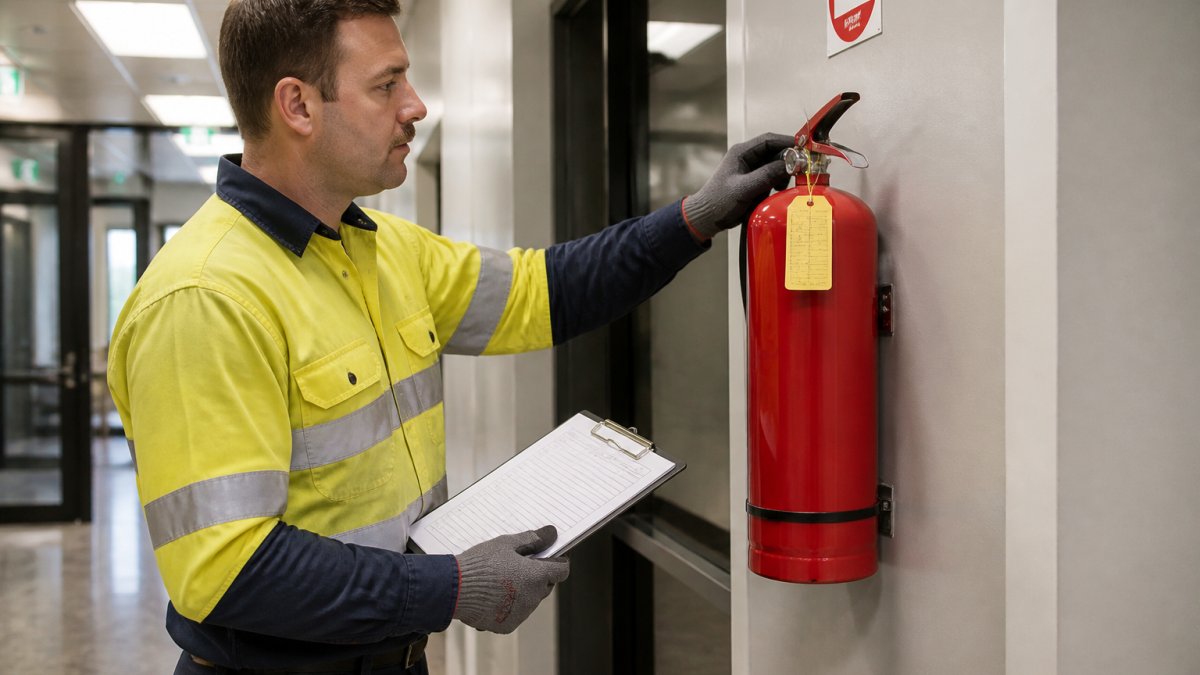
Most guides tell you to keep records but stop short of showing you what a good record looks like. For step-by-step guidance on documenting logbook entries correctly and staying audit-ready, see Fire Safety Logbook Documentation Tips: A How-To Guide.
A Reusable Fire Maintenance Record Template
Every entry should answer five questions: what was checked, when, by whom, in what condition, and what was done about any defect. The template below turns those questions into fields you can adopt immediately.
| Field | What to enter | Example entry |
|---|---|---|
| Asset ID | Unique tag or register number | FE-03-042 |
| System type | Category of equipment | Portable fire extinguisher (CO2) |
| Location | Building, level, room or grid reference | Level 2, plant room, east wall |
| Service date | Date the activity was performed | 14 March 2026 |
| Maintenance activity | Inspection, test, or service performed | Six-monthly inspection and pressure check |
| Condition found | Pass, defect, or observation | Pass, gauge in green, no corrosion |
| Defect reference | Logbook defect number, if any | Nil |
| Corrective action | Action taken and completion date | Not applicable |
| Technician | Name, licence or accreditation number | J. Citizen, licence 12345 |
| Signature | Signed by the technician | Signed |
| Next due | Date of next scheduled activity | 14 September 2026 |
A completed entry tells an auditor everything they need in one line. A missing field is a question they will ask.
A System-by-System Record Checklist
Use this checklist to confirm your logbook covers every asset and that the right evidence is filed for each one:
- Fire extinguishers: service tag attached and current, service report filed, asset ID matches the register
- Fire alarm system: test log with dates, zones tested and outcomes; defect notes cross-referenced
- Emergency lighting: duration and discharge test results recorded, battery condition noted, failed fittings logged
A common mistake is recording only the failures. Record the passes too. An auditor wants to see the full maintenance history, not just the problems. The template and checklist together give you a register that is complete, consistent and easy to audit.
Annual Fire Safety Statement Requirements and How Records Support Them
The annual fire safety statement is the formal declaration that a building’s fire safety measures are in place and working. It leans on your records.
The annual fire safety statement is a formal declaration tied to the building’s fire safety measures.
Records that support the statement include:
- Service reports for every system covered by the statement
- Maintenance certificates from accredited providers
- Defect and corrective action logs
- The current maintenance schedule showing everything is up to date
If a record is missing, do not sign around it. Chase the service report first. A statement backed by gaps is a compliance risk you carry all year.
Handling Failed Inspections, Defects and Overdue Corrective Actions
A failed inspection is not a crisis. An unrecorded one is. The way you handle defects in the paperwork decides whether an auditor sees a managed problem or a hidden one.
Follow this sequence:
- Log the defect the moment it is found, with the date and the equipment identification
- Rate the risk so urgent faults get fixed first
- Assign a corrective action with a named owner and a target date
- Record the fix with a completion date and the technician’s details
- Review overdue items at every maintenance cycle
Watch out: leaving a defect open with no target date is the fastest way to fail an audit. An open item with a plan looks responsible. An open item with nothing attached looks negligent.
Digital Fire Maintenance Software: Version Control and Storage
Paper logbooks get lost, damaged or left in a drawer. Digital fire maintenance software solves the storage problem, but only if you manage versions properly.
What good digital record management gives you:
- A single source of truth for every asset
- Timestamped entries that cannot be quietly edited
- Easy retrieval for audits and handover
- Automatic reminders for upcoming service dates
The trap is version control. When a service report is updated, the old version should be archived, not overwritten. Keep the audit trail intact.
Back up the system and restrict editing rights to named users. Learn how to set up a professional fire safety maintenance contract with proper testing schedules and record-keeping obligations.
Retention Periods: How Long to Keep Records and Where
How long you keep fire maintenance records depends on your jurisdiction and the type of record. There is no single figure that covers every property, so confirm the current requirement with your local regulator before you purge any file. Establishing a consistent system for these documents reinforces the broader importance of maintenance records across all operational assets, including those that keep your fleet running safely.
General Good Practice
As a working approach, records can be kept for the life of the system plus a buffer, and records tied to an open defect or a recent annual fire safety statement should not be destroyed. The logic is simple: the record must be available for as long as the system it describes is in service, and for long enough afterwards to answer any audit, insurance or due-diligence question.
A practical retention rule set looks like this:
- Current service reports and certificates: keep for the life of the system, plus at least the current and previous statement cycles
- Defect and corrective action logs: keep for the life of the system, and never destroy while a defect remains open
- Annual fire safety statements: keep a copy of every statement lodged, plus the service reports that support it
- Handover records: pass the complete set to the new owner or manager and keep a copy of the handover schedule
Jurisdiction-Specific Rules
Retention requirements can differ by state and territory. Before you destroy anything, check the current requirement with the relevant regulator for the state or territory where the building is located.
Confirm with the regulator which date the retention period runs from before you purge any file.
Watch out: applying a single retention period across a portfolio that spans more than one jurisdiction is the fastest way to destroy a record you were required to keep.
Where to Keep Records
Where you store records matters as much as how long you keep them. Store them so they are accessible on site and off site:
- On site: a logbook and a folder of current service reports for quick access
- Off site or digital: the full maintenance history, backed up and version controlled
- At handover: a complete record set passed to the new owner or manager
The Safe Work Australia publishes general guidance on record keeping and workplace safety duties that helps frame what to retain. When in doubt, keep it longer. Storage is cheap. A missing record is not.
Frequently Asked Questions
What fire safety records must building owners keep in Australia?
Building owners and occupiers should retain service reports, maintenance certificates, inspection and testing results, defect and corrective action logs, equipment asset registers and service tags for every fire protection system on site. Under AS 1851-2012 maintenance requirements, each routine maintenance activity needs a dated record showing the equipment identification, its location, the condition found and the work completed. These records form the audit evidence that an annual fire safety statement is built on.
How long do I need to keep fire maintenance records?
Retention periods vary by jurisdiction and by document type, so check the rules that apply to your property before discarding anything. As a working rule, keep service reports and maintenance certificates for the life of the system plus several years, and keep annual fire safety statements indefinitely while the building is occupied. Digital fire maintenance software makes long retention practical because records stay searchable and accessible rather than boxed in a storeroom.
Are digital fire maintenance records legally acceptable?
Digital records are widely accepted provided they are legible, attributable, dated and retrievable on request. The practical test is whether an authorised officer or auditor can review the record and confirm who did the work, when, on which asset and what condition was found. Digital fire maintenance software with version control and audit trails supports this better than paper logbooks, which are easily lost, damaged or altered.
Who is responsible for maintaining fire safety records in a strata building?
In a strata scheme, the owners corporation is generally responsible for maintaining the fire protection systems in common property and for keeping the associated records, while owners and occupiers carry obligations for their own lots and for not obstructing fire safety equipment. Body corporate managers should hold a single consolidated logbook covering every system, with clear handover notes when strata managers or service providers change.
Fire maintenance record keeping is not glamorous, but it is what stands between a clean audit and a costly dispute. If your logbook has gaps, or your service reports are too vague to prove the work, that is the moment to fix it. Fyrepower is fully insured and QBSA-licensed, with expertise in AS 1851 and AS 2444, and we build clear, audit-ready records into every maintenance and testing program. Get started with Fyrepower and turn your fire safety file into evidence you can trust.


