Last Updated: November 14, 2026
Quick Summary
To store flammable materials safely at work, first inventory every product using the Safety Data Sheets, then keep each hazard class in approved containers or cabinets, away from ignition sources and incompatible chemicals, with good ventilation. Inspect storage on a set schedule and keep records.
- Start with a full inventory, recording each substance’s quantity, location and container type.
- Check each Safety Data Sheet for the flash point and storage requirements.
- Use approved containers and purpose-built flammable storage cabinets rather than glass bottles or unlabelled drums.
- Keep storage away from heat, sparks, open flames, electrical switchboards and direct sunlight.
- Inspect storage daily, weekly, monthly and annually, and keep records that will stand up at an audit.
Table of Contents
- Identifying Flammable and Combustible Materials on Site
- Flammable Liquid Storage Requirements Australia Workplaces Must Meet
- Choosing Approved Containers and Flammable Storage Cabinet Requirements
- How to Store Flammable Chemicals at Work: Segregation, Ignition Sources and Ventilation
- Managing Spills, Leaks and Emergency Response Drills
- Flammable Cabinet Inspection Checklist and Recordkeeping
- Booking Your Flammable Storage Review With Fyrepower
- Frequently Asked Questions
Storing flammable materials safely at work is a legal duty for Australian businesses, and poor storage is a common source of workplace fire risk. This guide from Fyrepower walks through the practical steps to store flammable liquids, gases and solids in an industrial setting, from identifying what you hold on site to keeping records that will stand up at an audit.
Flammable materials are rarely the only hazard in a storage area. Ignition sources, poor ventilation and incompatible chemicals stored side by side can turn a small leak into a serious incident. The steps below follow the order most safety practitioners use when they assess a site, so you can work through them in sequence.
Identifying Flammable and Combustible Materials on Site
Start with a full inventory. Many sites discover products they forgot they held, such as old solvents, aerosols in a back room, or cleaning chemicals stored under a bench.
Check the Safety Data Sheet (SDS) for every product. The SDS lists the flash point, which tells you how easily a liquid gives off vapour that can ignite. Flammable liquids generally have a low flash point, while combustible liquids have a higher one but can still burn.
Record each substance with its quantity, location and container type. This list becomes the base for every decision that follows.
- Flammable liquids: solvents, paints, fuels, adhesives
- Flammable gases: propane, acetylene, LPG cylinders
- Flammable solids: some powders, metal shavings, certain plastics
- Aerosols: spray cans that contain flammable propellants
Flammable Liquid Storage Requirements Australia Workplaces Must Meet
Australian workplaces must manage hazardous chemicals under the Work Health and Safety (WHS) laws in their state or territory, and the Hazardous Chemicals Code of Practice guides how these duties apply. Safe Work Australia publishes the model WHS laws and codes that most jurisdictions adopt, so check the version that applies where your site is located (Safe Work Australia model WHS laws and hazardous chemicals guidance).
Storage quantities and separation distances for flammable and combustible liquids are set out in the relevant Australian Standards, and your fire authority may also set limits for how much you can keep in one area.
Keep these points in mind when you review your site:
- Confirm the rules in your state or territory, because they vary
- Check the quantity limit for each storage area
- Make sure exit routes stay clear and unobstructed
- Display hazard signs and labels on every storage area
Rules and limits can change, so verify current requirements with your state regulator or a qualified fire safety adviser before you finalise your layout.
Choosing Approved Containers and Flammable Storage Cabinet Requirements
Use containers designed for flammable liquids, such as approved safety containers. Glass bottles and unlabelled drums are a common cause of spills.
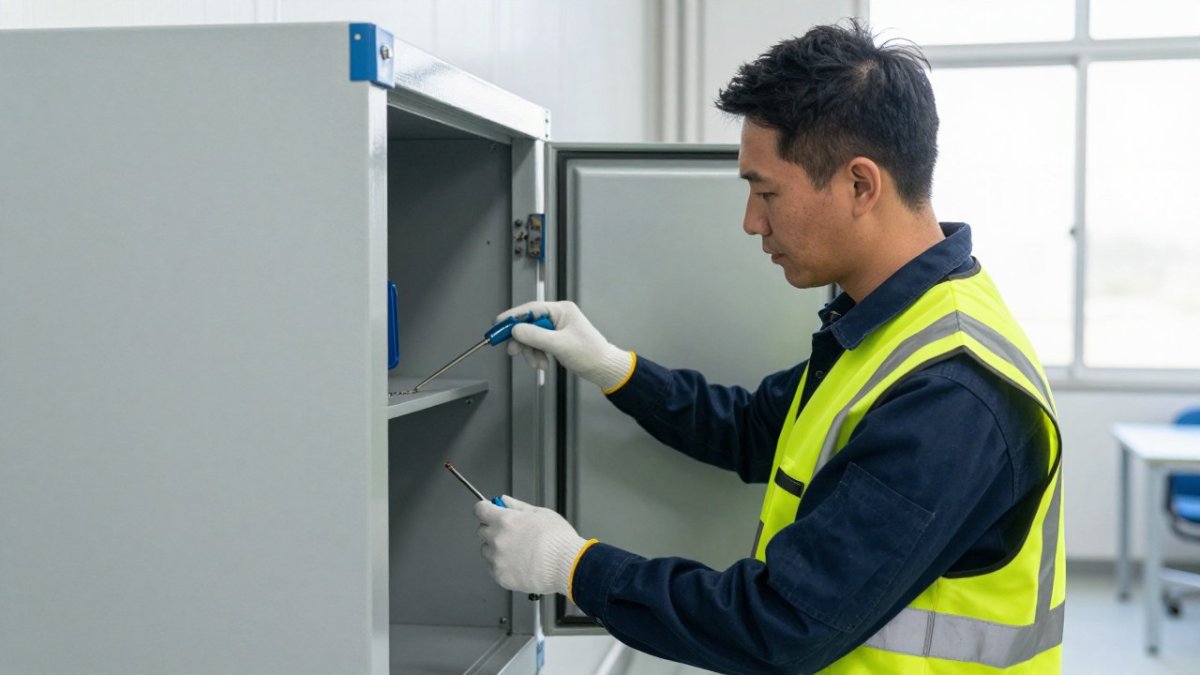
For larger quantities, a purpose-built flammable storage cabinet is the usual choice.
Common mistakes to avoid:
- Storing liquids in food or drink containers, even when labelled
- Leaving cabinet doors propped open during the day
- Keeping more stock outside the cabinet than the site limit allows
- Using a cabinet that is not rated for the substances you store
When choosing a cabinet, look for a construction rating and a clear label showing its fire resistance and the substances it suits, and check the requirements of the relevant Australian Standards and your local fire authority.
How to Store Flammable Chemicals at Work: Segregation, Ignition Sources and Ventilation
Good layout does most of the work, but the layout has to suit the material. A bay that is right for a drum of solvent is wrong for an LPG cylinder or a box of aluminium powder. Plan the storage area so that each material type is kept away from people, exits, ignition sources and anything it can react with.
Keep storage areas away from heat, sparks and open flames. This includes electrical switchboards, welding areas, hot plates, forklift charging bays and direct sunlight. Store containers in a cool, dry place with good airflow, and keep the area clear of combustible packaging, pallets and waste.
Segregating Incompatible Chemicals
Some chemicals react dangerously when they meet. Oxidisers, such as nitrates and peroxides, should be kept apart from flammable liquids. Acids and bases should also be separated from each other and from flammable materials.
Segregation is not only about liquids. Flammable gases in cylinders should be separated from oxidising gases such as oxygen, and acetylene should never be stored next to oxygen or LPG without a physical barrier and the clearances your supplier and AS 4332 recommend.
A common pattern is to group by hazard class rather than by product name. That way a new solvent arriving on site goes into the flammable liquids bay, not next to the pool chlorine because the labels look similar.
Ventilation and Vapour Control
Flammable vapours are heavier than air in many cases, so they can collect at floor level, in pits, in drains and in sumps. Good ventilation moves vapour away before it reaches a dangerous concentration.
Use mechanical extraction where natural airflow is not enough. Keep cabinets closed when not in use, and avoid storing containers in small, sealed rooms with no ventilation. Where gases are stored, ventilation should be at high and low level, because LPG and some other gases are heavier than air while others are lighter.
Watch out: a storage room that looks ventilated can still trap vapour in a corner, pit or drain. Test airflow at floor level, not just near the ceiling, and check that extraction is actually running rather than switched off to save power.
Material-Specific Storage Points
- Flammable liquids: store in approved containers and cabinets, keep decanting away from ignition sources, and bond and earth containers during transfer.
- Flammable gases: store cylinders upright and secured, keep valves closed and caps on, separate full and empty cylinders, and keep them away from heat and oxidisers.
- Aerosols: keep below the temperature limit on the can, away from heat and direct sun, and in a secured cage or cabinet so they cannot be knocked over.
- Flammable solids: keep dry, control dust, and separate from oxidisers and ignition sources.
If you are unsure which materials can share a bay, the SDS and your state or territory regulator’s hazardous chemicals guidance are the first places to check before you move stock.
Managing Spills, Leaks and Emergency Response Drills
Plan for spills before one happens. Keep spill kits close to storage areas, with absorbent material, neutralising agents where needed, and disposal bags. Place secondary containment, such as bunded trays, under containers to catch leaks.
Fire extinguishers must suit the type of fire you might face. Place them where they can be reached quickly and check that they are not blocked. Fire extinguisher installation should follow the relevant Australian Standards and your site’s risk assessment.
Run regular emergency drills. Staff should know where the nearest exit is, where the spill kit and extinguishers are kept, and who to call. Training should cover both the first response to a small spill and when to evacuate. Staff who handle these materials should complete fire safety training that covers warden roles and emergency procedures.
Flammable Cabinet Inspection Checklist and Recordkeeping
Inspection is only useful if it happens on a schedule and leaves a record. Set frequencies that match the risk: a daily visual check of the storage area, a monthly check of cabinets, containers and spill controls, and an annual review of the whole storage arrangement against AS 1940 and your state or territory requirements. High-use areas may need weekly checks.
What to Check and How Often
- Daily: cabinet doors closed and latched, no ignition sources in the area, exit routes clear, no obvious leaks or smells.
- Weekly: containers sealed, labelled and undamaged; spill trays clean and dry; spill kit stocked and in place.
- Monthly: incompatible chemicals still separated; ventilation running and airflow felt at floor level; cabinet labels legible; cylinder restraints secure.
- Annually: cabinet condition and door seals; ventilation performance; review of quantities against site limits; review of SDS currency; review of training records.
Use a simple checklist for each frequency and keep it with the storage area so staff can complete it without hunting for paperwork.
Recordkeeping That Survives an Audit
Keep records of every inspection, including the date, the name of the person who checked, any faults found and the action taken. Records are often the first thing an auditor asks for, and clear logbooks show that the work was actually done. For commercial fire alarm testing frequency and logbook requirements, see our dedicated guide.
Record the maintenance and servicing of fire equipment too. Commercial fire equipment, including alarms and extinguishers, is tested on a set cycle under the relevant Australian Standards. Check your maintenance schedule and the service records that apply to your building, and keep the certificates with your inspection log. If you want to check your site against Australian requirements, read how to conduct a fire safety audit in Queensland.
Closing the Loop on Faults
A checklist that finds faults but does not fix them is worse than no checklist, because it documents that you knew. Give each fault an owner and a due date, and record the date it was fixed. Review open faults at the monthly check so nothing sits unresolved for months.
Watch out: a cabinet that latches but no longer seals, or a spill tray that has been used and not replaced, will pass a quick visual check and fail an audit. Test the mechanism, not just the appearance.
The article sets out how often each storage check should happen, so a reader can see the schedule at a glance.
| Frequency | What to check |
|---|---|
| Daily | Cabinet doors closed, exit routes clear, no ignition sources |
| Weekly | Containers sealed and labelled, spill trays clean, spill kit stocked |
| Monthly | Incompatible chemicals separated, ventilation running, cylinder restraints secure |
| Annually | Cabinet seals, ventilation performance, quantities against site limits |
Booking Your Flammable Storage Review With Fyrepower
If you are not sure whether your current setup meets the rules, a professional review is the fastest way to find gaps. Fyrepower is a fully insured, QBSA-licensed fire protection business serving the Gold Coast, South Brisbane and Northern New South Wales. Our team can help with fire protection services and training for your site.
Visit our website to see the services we offer and request a quote. Get in touch with us now to arrange a storage review for your site.
Frequently Asked Questions
How should flammable materials be stored in an industrial workplace?
Store flammable materials in approved containers and, where quantities require it, in a purpose-built flammable storage cabinet. Keep the storage area away from ignition sources such as hot work, electrical equipment and direct sunlight, and separate incompatible chemicals such as oxidisers and acids. Ensure the area has adequate ventilation to control vapour build-up, has spill containment and clear hazard signage, and is restricted to trained staff. Check the quantity limits that apply under the relevant Australian standards and state work health and safety regulations, as these depend on the substance class and the building.
Do flammable liquids need to be stored in a flammable storage cabinet?
Not always, but a flammable storage cabinet is the usual way to meet storage requirements once quantities exceed small working amounts. Cabinets built to recognised Australian standards provide fire resistance, containment and controlled access. Smaller quantities may be stored in approved safety containers in a suitable area, provided the total quantity and location meet the applicable limits. Your storage assessment should confirm which option applies to each substance and site before you decide.
How often should flammable storage cabinets be inspected?
Inspect flammable storage cabinets at regular intervals as part of your workplace maintenance program, and check them more often if they are heavily used or exposed to harsh conditions. Each inspection should confirm that doors close and latch properly, self-closing mechanisms work, seals are intact, containment sumps are clear, labels are legible and no damaged containers are stored inside. Record each inspection with the date, the inspector’s name and any corrective action taken, so you can demonstrate compliance during an audit.