Last Updated: November 11, 2026
Quick Summary
Fire safety legal obligations for property managers are operational: you schedule statutory inspections, keep maintenance records and certificates accessible, report defects to the owner or body corporate promptly, and maintain evacuation plans. The legal duty itself usually sits with the building owner, occupier or body corporate, not the manager.
- The manager’s role is to coordinate and document fire safety, not to absorb the owner’s liability.
- A lease clause shifting responsibility to a tenant does not remove the owner’s statutory duty.
- AS 1851 requires the inspection and maintenance schedule to be documented system by system.
- A defensible records pack includes defect logs showing the date identified, party notified and date resolved.
- Critical defects such as a failed fire alarm need immediate escalation and interim measures.
Table of Contents
- Who Is Legally Responsible for Fire Safety in a Managed Property
- Property Manager Fire Safety Responsibilities Explained
- Fire Safety Responsibilities in Commercial Leases
- Fire Safety Equipment Inspection and Maintenance Requirements
- Fire Safety Maintenance Records and Audit Readiness
- Defect Escalation and Emergency Response for Property Managers
- Booking Your Fire Safety Compliance Review
- Frequently Asked Questions
Who Is Legally Responsible for Fire Safety in a Managed Property
Fire safety legal obligations for property managers sit across a chain of duty holders, not with one party alone, and understanding these fire safety legal obligations is essential. Under Australian work health and safety and building fire safety law, the building owner, the occupier, the body corporate and the property manager each carry defined duties. This guide explains how those duties overlap, what records prove compliance, and how to escalate defects before they become liabilities.
The manager’s role is to coordinate and document, not to absorb the owner’s liability. Safe Work Australia’s model WHS framework sets the national baseline, but each state and territory enforces its own building fire safety rules. In Queensland, the Queensland Fire Department’s building fire safety framework places clear obligations on occupiers to maintain fire safety installations. Managers who confuse coordination with ownership are the ones caught short at audit.
For the full regulatory picture, see the complete guide to fire safety regulations for commercial property managers.
Property Manager Fire Safety Responsibilities Explained
A property manager’s fire safety responsibilities are operational: arrange inspections, keep records, act on defects, and ensure occupants know what to do. The manager rarely holds the legal duty directly; the owner or body corporate does. What the manager controls is whether the evidence exists to prove that duty was met.
The practical split looks like this:
- Schedule statutory inspections and testing on time
- Keep maintenance records and certificates accessible
- Report defects to the owner or body corporate promptly
- Maintain evacuation plans and occupant information
- Coordinate fire safety training where the lease requires it
A common mistake is treating a service report as proof of compliance. It is not. The report proves work was done; it does not prove the building meets every obligation. Our advice is to map each duty to a document before the auditor asks.
For the standards behind these duties, read the top 10 fire safety standards for commercial properties.
Fire Safety Responsibilities in Commercial Leases
Lease terms decide who does what, but they cannot override statutory duties. A commercial lease might make the tenant responsible for testing smoke alarms, while the owner retains responsibility for essential safety measures. Shared buildings add a third layer: the body corporate handles common property, and the manager coordinates between parties.
The responsibility matrix below is the one we use to clarify disputes:
| Party | Typical duty | Evidence required |
|---|---|---|
| Building owner | Maintain essential safety measures | Maintenance certificates |
| Occupier/tenant | Keep premises safe, report defects | Defect logs, correspondence |
| Body corporate | Common property systems | Committee records, contracts |
| Property manager | Coordinate, schedule, document | Inspection schedule, reports |
Watch out: a lease clause that shifts responsibility to a tenant does not remove the owner’s statutory duty. Regulators act against the duty holder, not the contract.
Fire Safety Equipment Inspection and Maintenance Requirements
Fire safety equipment inspection and maintenance should be planned against the relevant Australian standards, which set out routine servicing requirements for fire protection systems and equipment.
A practical way to read AS 1851 is to separate three activities that are often lumped together:
- Inspection, a visual check that the system is in place, undamaged and unobstructed. Inspection frequency varies by item and should follow the applicable standard.
- Testing, an operational check that the system will perform as intended. Testing intervals depend on the system type and the applicable standard.
- Maintenance, the scheduled servicing, replacement and repair work that keeps the system within its design tolerances, carried out by a competent technician.
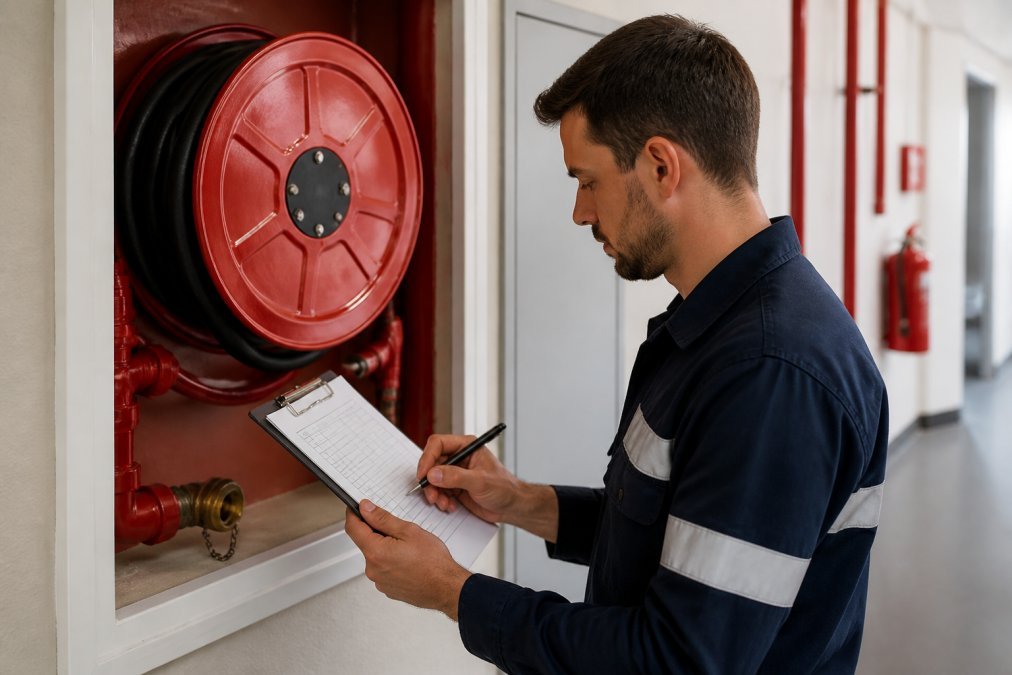
The systems most commonly found in managed commercial buildings, and the intervals that typically apply, include:
| System | Typical routine activity | Common interval |
|---|---|---|
| Portable fire extinguishers | Visual inspection; pressure and tag check | Monthly |
| Portable fire extinguishers | Full service and test | Six-monthly |
| Fire hose reels | Visual inspection; flow and pressure test | Six-monthly |
| Smoke alarms and detection systems | Inspection and functional test | Monthly to annual, by system type |
| Evacuation lighting and exit signs | Inspection and discharge test | Monthly and six-monthly |
| Fire doors and passive systems | Inspection of operation and integrity | As scheduled under the standard |
These intervals are indicative only. The standard, the system manufacturer’s requirements and any condition imposed by the building’s approval will determine the actual schedule, and a competent technician should confirm it for each property.
The thing nobody tells you about AS 1851 is that the schedule has to be documented system by system. A single “annual inspection” certificate does not prove that every installation was tested at the right interval.
A service report that records work as done is not the same as a schedule that proves every system was serviced on time. If the schedule and the reports do not reconcile, the gap is what an auditor will find.
Fyrepower’s QBSA-licensed team has expertise in Australian safety standards, including AS2444 and AS1851. For the detailed 2026 breakdown, see the AS1851 fire maintenance requirements guide.
Fire Safety Maintenance Records and Audit Readiness
Audit readiness comes down to records that stand alone. A vague service report that says “checked and okay” will not survive scrutiny.
A defensible records pack for a managed property typically includes:
- Maintenance schedules and completed test reports for each system
- Certificates of inspection and service for each installation
- Defect logs with the date identified, the responsible party notified, the rectification deadline and the date resolved
- Evacuation plans, occupant information and training records
- Annual fire safety statement documentation where the jurisdiction requires it
- Correspondence with the owner, body corporate or tenant about defects and repairs
The gap most managers fall into is keeping records in one place and defects in another. When an auditor asks why a fault was not fixed, the answer needs to be in the same file as the report that identified it. A single register per property, updated after every visit, closes that gap.
A register that works in practice has one row per system and one column per required activity, with the date last completed, the date next due and a link to the supporting report. Defects sit in the same register, with the date raised, the party notified and the date closed out.
Watch out: a defect that is logged but never escalated looks worse at audit than a defect that was escalated and is still being tracked. The record of notification and follow-up is what shows the manager acted.
Where the jurisdiction requires an annual fire safety statement or equivalent, the statement is only as strong as the records behind it. The statement certifies that the essential safety measures are in place and functioning; the maintenance records are the evidence.
For lodgement rules and deadlines, check the annual fire safety statement compliance guide.
Defect Escalation and Emergency Response for Property Managers
Defect escalation needs a defined path, not an inbox. When a technician identifies a fault, the manager should log it, notify the responsible party in writing, set a rectification deadline, and confirm the fix. Critical defects, such as a failed fire alarm or an empty extinguisher, need immediate escalation and interim measures.
Emergency response planning is the other half. Occupants need clear evacuation procedures, and managers need to know who coordinates on the day. Vulnerable occupants and accessibility requirements deserve specific attention, not a generic clause. Australian Standard AS 3745 sets out the planning requirements for evacuation, and it is worth reading alongside your building’s own plan.
The real difference between a smooth evacuation and a chaotic one comes down to rehearsal. Plans on paper do not move people; practice does.
Booking Your Fire Safety Compliance Review
A compliance review is the practical next step for any manager unsure where the gaps are. It maps each duty to a document, tests the schedule against AS 1851, and flags defects before an auditor does. Fyrepower provides testing, equipment and training services, and is fully insured and QBSA-licensed.
To prepare, work through the 7 steps to pass an annual fire safety inspection. It turns the review into a checklist you can act on.
Fire safety legal obligations for property managers are manageable when duties, records and escalation paths line up. If you are unsure whether your buildings would pass an audit, start with a review. Fyrepower offers 6-monthly testing, AS 1851-aligned maintenance, and detailed reporting that holds up under scrutiny, backed by our 55-month warranty and on and offsite fire training. Get started with Fyrepower and put your compliance evidence in order before the next inspection.
Frequently Asked Questions
Who is responsible for fire safety in a managed property?
Responsibility is shared and set by state and territory law plus the lease. The building owner or body corporate typically holds the core duty for fire safety installations and essential safety measures, while the property manager carries out day-to-day coordination: arranging inspections, keeping records and escalating defects. Tenants usually handle housekeeping duties inside their tenancy, such as keeping exits clear and not tampering with equipment. Always check the specific lease terms and local regulations, because the split varies between commercial and strata properties.
What fire safety obligations do property managers have?
Property managers usually coordinate rather than own the legal duty. That means scheduling routine inspections and testing, keeping maintenance records audit-ready, making sure contractors are licensed and insured, and escalating any defect that affects occupant safety. You also need to confirm that evacuation plans and signage are current and that tenants know their own obligations under the lease. Documenting each step matters, because if a regulator or insurer asks for evidence, vague service reports will not prove the work was done.
How often should fire safety equipment be inspected and maintained?
Frequency depends on the equipment and the applicable standard. Smoke alarms, extinguishers, exit signs and emergency lighting each carry their own inspection intervals, and some items require six-monthly servicing. AS 1851 sets out routine servicing schedules for fire protection systems and equipment, and your fire risk assessment should confirm what applies to your building. Build a maintenance calendar around those intervals so deadlines are not missed, and keep every service report on file.
What fire safety maintenance records should a property manager keep?
Keep inspection and testing reports, service records, contractor licences and insurance certificates, defect logs with escalation dates, evacuation plan reviews and training records. Store them so they can be produced quickly during an audit or insurance claim. Records should name the equipment tested, the date, the result and any defects found, with the corrective action taken. Detailed reports are the difference between proving compliance and being unable to show that required work was completed.
What should a property manager do if a fire safety defect is found?
Log the defect immediately with the date, location and severity, then notify the owner or body corporate in writing. Defects affecting life safety, such as a failed alarm or blocked exit, need urgent escalation and interim measures until repaired. Book a qualified contractor to rectify the issue and keep the repair report with your maintenance records. Following a clear escalation path protects occupants and gives you documented evidence that you acted promptly if questions are later raised.
Do fire safety obligations differ between commercial and residential properties?
Yes. Commercial properties generally face more extensive requirements, including fire risk assessments, documented maintenance schedules and evacuation planning under work health and safety and building laws. Residential and strata properties have their own obligations around smoke alarms and common property systems, with body corporate involvement in shared areas. Because the rules are set at state and territory level, confirm the requirements that apply to your specific building type and location before setting your compliance program.