Table of Contents
- What You’ll Need Before You Start
- Understanding Your Fire Safety Schedule and Annual Fire Safety Statement
- Fire Safety Inspection Frequency: Your 6-Monthly and Annual Testing Timeline
- Essential Safety Measures Compliance Checklist
- How to Verify QBSA Fire License and Regulatory Obligations
- Multi-Tenancy Responsibility Breakdown for Strata Properties
- Common Mistakes to Avoid When Managing Fire Safety Deadlines
- What to Do If You’ve Missed a Compliance Deadline
- Frequently Asked Questions
Last Updated: August 29, 2026
What You’ll Need Before You Start
Managing fire safety deadlines effectively requires a clear understanding of your regulatory obligations, a documented system for tracking compliance dates, and access to qualified fire safety practitioners. Gather your building’s fire safety documentation, contact details for a QBSA-licensed fire safety provider, a calendar or digital tracking system for compliance dates, and any relevant lease agreements or body corporate by-laws. If you manage multiple properties, implement a centralised compliance register that tracks all fire safety deadlines across your portfolio. Properties that establish systems early rarely miss deadlines; those that wait until the last minute scramble and sometimes fail audits.
Understanding Your Fire Safety Schedule and Annual Fire Safety Statement
Your Fire Safety Schedule (FSS) is the statutory document outlining every essential safety measure your building must maintain, the testing and inspection frequency required, and who’s responsible for each task. It identifies all fire protection systems: sprinklers, fire extinguishers, emergency lighting, exit signage, fire doors, and smoke detection systems. For each system, the schedule specifies testing intervals, maintenance requirements, and documentation standards.
Your Annual Fire Safety Statement (AFSS) is the formal declaration, signed by a qualified fire safety practitioner, confirming that all essential safety measures have been tested, inspected, and maintained according to the schedule. Without a current AFSS, you’re non-compliant, even if the work was technically done. The AFSS must be prepared within a specific timeframe each year. Many property managers miss this deadline because they confuse it with individual testing deadlines. You might complete all your 6-monthly fire extinguisher testing, but if you don’t have a signed AFSS confirming all work is done, you’re still out of compliance.
| Document | Purpose | Frequency | Deadline |
|---|---|---|---|
| Fire Safety Schedule | Identifies all systems and testing requirements | Created once, updated if systems change | N/A, permanent reference |
| Annual Fire Safety Statement | Confirms all required work is completed | Prepared annually | Within statutory timeframe |
| Testing Records | Evidence of individual system inspections | Generated per testing interval | Must support AFSS |
Fire Safety Inspection Frequency: Your 6-Monthly and Annual Testing Timeline
How often you test fire safety systems depends on the system type and your building’s classification. Fire extinguishers typically require 6-monthly inspection and annual professional servicing (qbcc.qld.gov.au). Emergency lighting systems need annual testing to confirm they activate and provide adequate illumination during power failure (qbcc.qld.gov.au). Exit signage must be inspected regularly to ensure visibility and functionality. Sprinkler systems require annual inspection and testing of key components. Fire doors need periodic checks to confirm they close properly and seals are intact. Smoke detection systems require testing as specified in the FSS, often quarterly or semi-annually depending on building type.
The critical mistake is treating all testing as equally urgent. Your FSS specifies the actual requirements for your building. Follow the FSS, not a generic service provider’s standard checklist.
The 90-day compliance window
The 90-day compliance window is the period immediately after your Annual Fire Safety Statement deadline passes. If you haven’t completed all required testing and obtained your signed AFSS within this window, you’re in breach of statutory obligations.
Your AFSS must be prepared by a specific date each year. From that date, you have 90 days to ensure all essential safety measures have been tested and the AFSS has been signed by a qualified fire safety practitioner. Many property managers misunderstand this as a 90-day grace period to do the testing. It’s not. The testing must be completed by the AFSS deadline. The 90-day window is simply the period during which the AFSS must be formally prepared and signed.
The practical implication: start your testing schedule early enough that all work is complete at least 2-3 weeks before the AFSS deadline. This gives your fire safety practitioner time to review all documentation, identify any gaps, and prepare the final statement without rushing.
Essential Safety Measures Compliance Checklist
Essential safety measures are the specific fire protection systems and features your building must maintain. These aren’t optional extras, they’re statutory requirements identified in your Fire Safety Schedule.
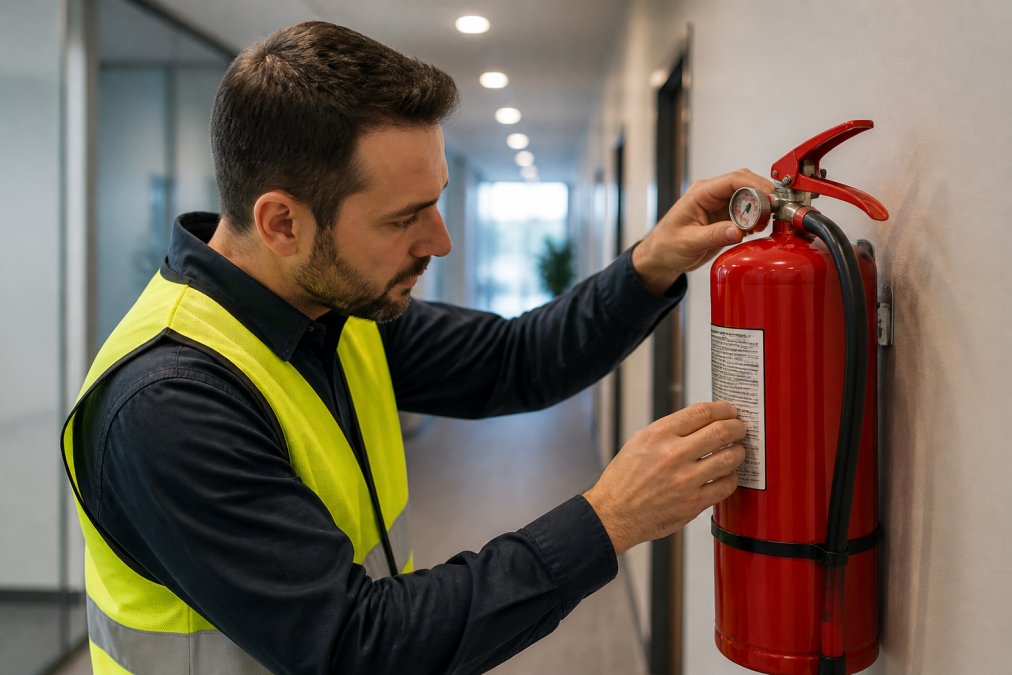
Your essential safety measures likely include:
- Fire extinguishers: Portable units placed throughout the building. Require 6-monthly inspection and annual professional servicing.
- Fire hoses and hydrants: Fixed water supply systems for larger fires. Require annual pressure testing and maintenance.
- Emergency lighting: Battery-powered lights that activate during power failure. Require annual testing to confirm operation.
- Exit signage: Illuminated or reflective signs marking escape routes. Require regular inspection for visibility and functionality.
- Smoke detection systems: Interconnected smoke alarms or detection networks. Require testing at intervals specified in your FSS.
- Fire doors: Doors designed to resist fire and smoke spread. Require periodic inspection to confirm proper closure and seal integrity.
- Sprinkler systems: Automatic water suppression systems. Require annual inspection and periodic testing of key components.
Fire protection systems testing
Fire protection systems testing means verifying that systems function as designed and documenting the results. Fire extinguisher testing involves checking pressure gauges, inspecting for visible damage, confirming accessibility and signage, and verifying that the correct extinguisher type is in the right location. Annual professional servicing includes opening the extinguisher, inspecting internal components, and recharging or replacing it if necessary.
Sprinkler systems require annual inspection of visible components: checking that sprinkler heads aren’t blocked, inspecting pipes for corrosion or damage, and testing water pressure. Hydrant testing involves pressurising the system, checking flow rates, and inspecting connections and seals.
The key to managing fire protection systems testing is clarity in your service agreements. Specify exactly what testing will be done, what documentation you’ll receive, and when results must be delivered.
Maintenance records and documentation
Documentation is where many compliance failures originate. You can complete all required testing, but if you can’t prove it, auditors and regulators will treat you as non-compliant.
Maintenance records must include: the date of testing, the system or equipment tested, the name and qualifications of the person who performed the test, specific results or measurements taken, any defects identified, and any corrective actions completed. A service report that simply says “fire extinguishers inspected” without a date is worthless. A detailed report listing each extinguisher, its location, pressure reading, condition, and any work performed is what regulators expect to see.
Digital compliance tracking systems have transformed how many property managers handle this. Instead of filing loose service reports, they maintain a centralised register showing every testing event, deadline, and document. When an audit occurs, they can instantly produce a complete compliance history.
Store records for at least seven years. Fire safety incidents can take years to litigate, and auditors may request historical documentation.
How to Verify QBSA Fire License and Regulatory Obligations
A QBSA-licensed fire safety practitioner is the only person legally qualified to prepare your Annual Fire Safety Statement. QBSA stands for Queensland Building and Construction Commission. Their fire safety practitioner license is a statutory qualification that requires specific training, demonstrated competency, and ongoing professional development.
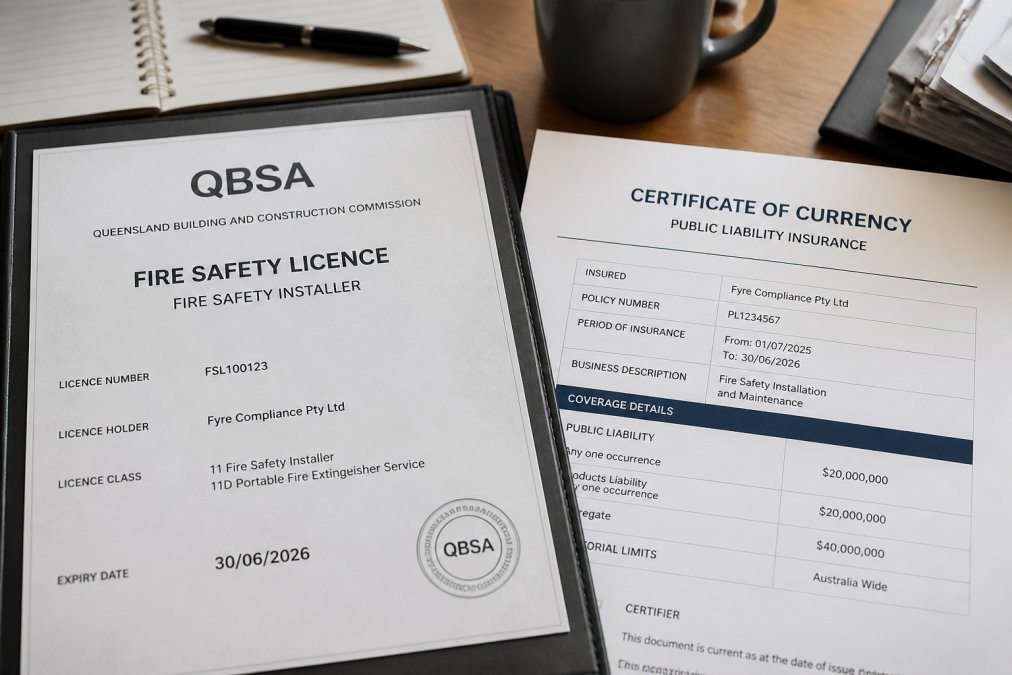
To verify a fire safety practitioner’s QBSA license, visit the QBSA public register, which lists all licensed practitioners and their current status. Search by name or company. The register shows licence type, expiry date, and any disciplinary history. If a practitioner’s name doesn’t appear or their licence has expired, they’re not legally qualified to prepare your AFSS.
Your regulatory obligations depend on your building type and occupancy. Residential buildings, commercial offices, retail spaces, hospitality venues, and industrial facilities all have different fire safety requirements. The person responsible for fire safety compliance is typically the building owner or, in strata properties, the body corporate. If you’re a property manager, you’re responsible for ensuring the building owner or body corporate meets their obligations.
Multi-Tenancy Responsibility Breakdown for Strata Properties
Strata properties create unique fire safety compliance challenges because responsibility is shared between the body corporate, individual lot owners, and sometimes tenants.
The body corporate is responsible for common property fire safety: the building’s main systems, exit routes, emergency lighting, and signage. This includes fire extinguishers in common areas, sprinkler systems serving the entire building, and emergency evacuation procedures. The body corporate must ensure the Fire Safety Schedule is prepared and updated, and they must arrange for the Annual Fire Safety Statement to be prepared each year.
Individual lot owners are responsible for fire safety within their own lots: fire extinguishers in their unit or office, smoke alarms, and maintaining clear access to emergency exits. Tenants have a responsibility to use fire safety systems correctly and report defects, but they aren’t responsible for maintaining systems.
Many strata properties solve coordination challenges by including fire safety responsibilities in the by-laws and lease agreements. The by-laws specify what the body corporate will maintain, and leases clarify tenant obligations. Annual notices reminding lot owners and tenants of their responsibilities reduce disputes and improve compliance.
Common Mistakes to Avoid When Managing Fire Safety Deadlines
Fire safety compliance has a binary outcome: you’re either compliant or you’re not. Understanding common mistakes helps you avoid the traps that catch other property managers.
The first mistake is assuming that completing testing means you’re compliant. Testing is necessary but not sufficient. You also need a current, signed Annual Fire Safety Statement. Many property managers complete all their 6-monthly testing but miss the AFSS deadline because they didn’t schedule the final practitioner review and sign-off early enough.
The second mistake is using unqualified service providers. A technician who can perform fire extinguisher servicing is not the same as a QBSA-licensed fire safety practitioner. Always verify QBSA licensing before engaging a service provider.
The third mistake is poor documentation. Service reports that lack detail, dates, or the technician’s name are essentially useless. Detailed records are your defence against audit scrutiny.
The fourth mistake is treating all fire safety systems as equally urgent. Your Fire Safety Schedule specifies different testing intervals for different systems. Match your testing schedule to your FSS, not to a generic provider’s standard package.
The fifth mistake is managing deadlines reactively instead of proactively. Property managers who wait until a deadline is approaching scramble to book technicians. Those who plan testing 8-12 weeks in advance secure appointments and complete testing with time to spare.
The sixth mistake is not tracking multiple properties centrally. Managers of 10+ properties often miss deadlines on some properties while staying compliant on others. A centralised register showing all testing dates, AFSS deadlines, and outstanding tasks prevents this.
What to Do If You’ve Missed a Compliance Deadline
If you’ve missed a fire safety deadline, the immediate priority is stopping the clock on non-compliance.
First, contact a QBSA-licensed fire safety practitioner immediately. Explain your situation and ask them to assess the gap and create a recovery plan. Second, notify your building owner or body corporate and your insurance provider. Non-compliance creates liability exposure. Third, create a written recovery plan with specific dates for each testing event and the final AFSS preparation. Fourth, once all testing is complete, engage a fire safety practitioner to prepare an updated Annual Fire Safety Statement. Fifth, implement systems to prevent future gaps, whether that’s a digital compliance register, calendar reminders, or engaging a service provider on a retainer basis.
The cost of recovering from a missed deadline typically exceeds the cost of staying proactively compliant.
Managing fire safety deadlines is fundamentally about systems and discipline. Properties that establish clear processes, engage qualified practitioners, and track deadlines centrally stay compliant consistently. Those that treat fire safety as a reactive task scramble, miss deadlines, and face regulatory consequences.
Fyrepower helps property managers and building owners eliminate deadline pressure by managing the entire compliance cycle: scheduling testing, performing inspections with detailed documentation, and preparing Annual Fire Safety Statements on schedule. Our QBSA-licensed team ensures your building meets all Australian fire safety standards, and our comprehensive reporting gives you the documentation you need for audits. Get in touch with us now to transform your fire safety compliance from a source of stress into a managed, predictable process.
Frequently Asked Questions
What is the difference between a fire safety schedule and an annual fire safety statement?
A fire safety schedule outlines all essential safety measures in your building and their testing requirements. An Annual Fire Safety Statement (AFSS) is the formal document you must submit confirming that all measures listed in the schedule have been tested and maintained within the compliance period. The schedule is your blueprint; the AFSS is your proof of compliance.
How often must fire safety equipment be inspected and certified?
Most essential safety measures require regular testing and certification. Fire extinguishers, hydrants, and suppression systems often fall under a 6-monthly cycle, while some systems like emergency lighting may have different intervals. Your fire safety schedule specifies exact frequencies for each system. Missing even one deadline puts you out of compliance.
How do I verify a fire safety provider’s QBSA license before hiring them?
Check the QBSA register at qbcc.qld.gov.au and search by company name or license number. Verify the license is current and covers fire safety work. Ask for their certificate of currency for public liability insurance. Request references from other property managers they service. A legitimate provider will have no issue providing these details upfront.
What happens if I miss a fire safety compliance deadline?
Non-compliance can result in significant penalties, enforcement action from building regulators, and potential liability issues if a fire occurs. Your building certification may be suspended. For strata properties, body corporate can face fines. The best recovery step is to schedule testing immediately, document the delay, and notify your insurer.
This article was written using GrandRanker