Last Updated: November 5, 2026
Quick Summary
Common emergency lighting compliance failures in Queensland are batteries that were never load-tested, exit signs nobody looked at, and logbooks missing entire years of entries. Each fitting must deliver its rated light output for at least 90 minutes on battery power alone under AS/NZS 2293, and a timed discharge is the only meaningful proof.
- AS/NZS 2293 requires each emergency light and exit sign to run at least 90 minutes on battery power alone.
- Batteries are a common cause of failed discharge tests, as capacity can decline over time.
- Routine checks are visual, six-monthly testing confirms battery switchover, and the discharge test proves full duration.
- Strata complexes usually fail audits on the logbook evidence trail rather than on the hardware itself.
- After a failed test, replace failed batteries and fittings on escape routes immediately, then update the logbook.
Table of Contents
- Why Emergency Lighting Compliance Fails So Often in Queensland Buildings
- The Emergency Lighting Testing Requirements Australia Building Owners Must Meet
- Common Emergency Lighting Faults Found on Site
- Inside the 90-Minute Emergency Lighting Discharge Test
- Your Emergency Lighting Compliance Checklist for Each Requirement
- How Building Type Shapes Which Failures You See
- After a Failed Test: Remediation Priorities and the Evidence You Need
- Book a Compliance Test Before Your Next Audit
- Frequently Asked Questions
Why Emergency Lighting Compliance Fails So Often in Queensland Buildings
Emergency lighting compliance is the practice of ensuring every exit sign and backup light in a building meets the testing, duration and documentation requirements set by Australian Standards. The same failures tend to repeat across commercial sites: batteries that were never load-tested, exit signs nobody looked at, and logbooks missing entire years of entries.
The stakes are higher than most building owners assume. The Complete Guide to Emergency Lighting Compliance in Australia confirms that emergency lighting systems must operate for a minimum of 90 minutes following mains power failure, a requirement drawn from AS/NZS 2293. Fail that, and the building’s evacuation capability fails with it.
Most compliance failures are not dramatic. They are quiet, cumulative and entirely preventable. Below, we break down what actually goes wrong, how each fault is detected, and what evidence you need to prove you fixed it.
The Emergency Lighting Testing Requirements Australia Building Owners Must Meet
Several documents govern the work, including AS/NZS 2293, the building fire safety regulation applying in your state, and the maintenance schedule in AS1851. Together they set the frequency, the pass criteria and the recordkeeping obligations that apply to every fitting on site.
What AS/NZS 2293 Requires of Every Fitting
AS/NZS 2293 requires each emergency light and exit sign to deliver its rated light output for at least 90 minutes on battery power alone. The standard covers three things:
- Duration: a full 90-minute discharge on demand, not a simulated estimate
- Illumination: enough light on the exit path and signage to guide occupants safely
- Documentation: results recorded at each test interval and retained for audit
A fitting that lights up for ten seconds during a visual check tells you almost nothing. The only meaningful proof is a timed discharge.
Queensland buildings carry additional maintenance obligations layered on top of the standard. Emergency lighting maintenance standards for Queensland businesses set out how those obligations apply in practice for local property owners. Emergency Lighting Maintenance Standards for Queensland Businesses sets out how those obligations apply in practice for local property owners.
Common Emergency Lighting Faults Found on Site
The faults that fail audits cluster into two groups: battery problems and hardware problems. Both are predictable, and both show up long before a test fails if anyone is looking.
Battery Failure and Chemical Decay
Batteries are a common cause of failed discharge tests, as capacity can decline over time.
Heat accelerates the decline. Heat can accelerate battery decline, so fittings in warm locations may fail earlier than similar units in cooler areas.
Failed Fittings, Lamps and Wiring
Hardware faults are more visible but often missed because nobody climbs a ladder to check. Watch for:
- Burnt-out lamps and degraded LEDs that still glow but no longer meet output
- Faulty wiring and loose electrical connections at the fitting or the switch circuit
- Non-compliant products installed by a previous contractor without certification
- Exit signs with failed internal illumination or obscured evacuation signage
A common mistake is replacing a lamp without testing the circuit. If the connection is faulty, the new lamp fails the next discharge too.
Inside the 90-Minute Emergency Lighting Discharge Test
The 90-minute emergency lighting discharge test is the test that best demonstrates a fitting’s rated duration during an evacuation. The technician isolates mains power to the circuit, times the run, and records the result for every individual fitting.
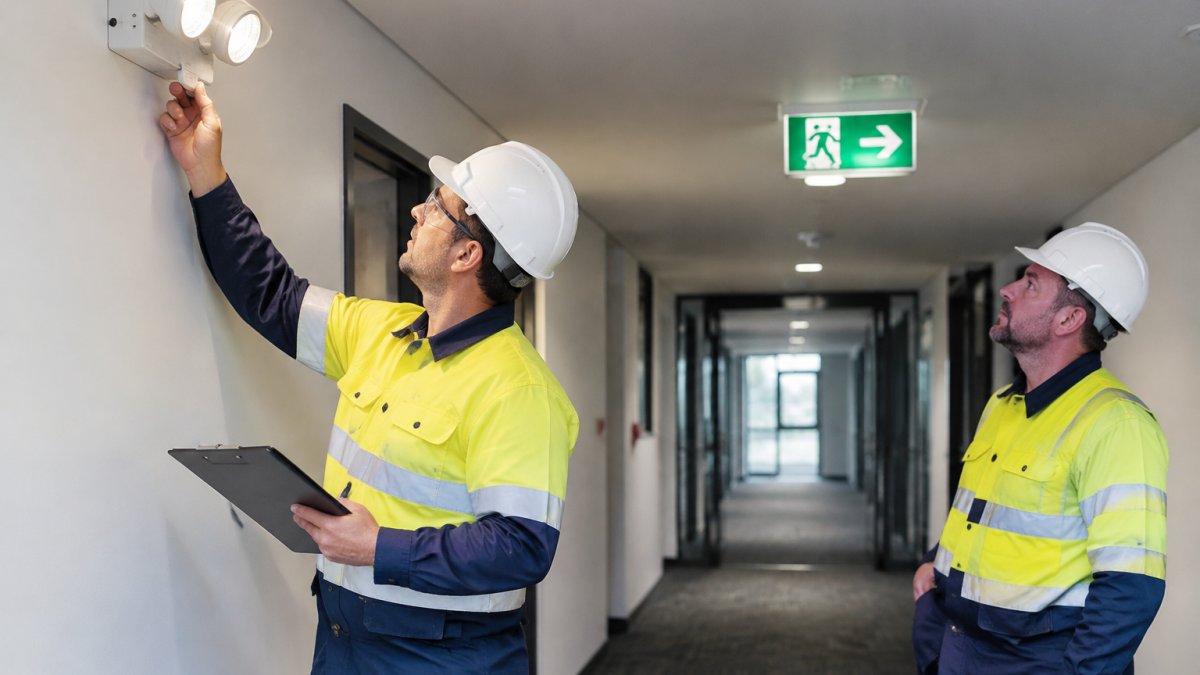
For the detailed frequency, discharge procedure and logbook rules that apply to exit lights specifically, see exit light testing requirements under AS/NZS 2293.2.
Your Emergency Lighting Compliance Checklist for Each Requirement
Use this checklist to map each compliance obligation to the failure it prevents and the evidence an auditor will ask for.
| Requirement | Common Failure | Evidence Needed |
|---|---|---|
| 90-minute discharge | Battery decay, short run time | Timed result per fitting |
| Visual inspection | Obscured or damaged signage | Dated inspection record |
| Six-monthly test | Missed intervals | Signed test report |
| Logbook upkeep | Gaps in entries | Complete, current logbook |
| Licensed testing | Unqualified contractor | Licence and scope on file |
Routine Checks, Six-Monthly Testing and the Discharge Test: What’s the Difference?
These three activities are often confused, and the confusion is where compliance gaps open up.
- Routine checks are visual: is the fitting damaged, is the sign visible, is the indicator lit?
- Six-monthly testing confirms each fitting switches to battery mode when mains is interrupted.
- The discharge test runs the battery for the full 90 minutes to prove duration.
The full maintenance schedule governing these intervals is set out in AS1851 fire maintenance requirements. Skipping the middle tier creates false confidence: the light works for a moment, so everyone assumes it will work for an hour.
How Building Type Shapes Which Failures You See
Failure patterns follow building type closely, and knowing which failures are typical of your site lets you target the inspection rather than hoping a general walk-through catches everything. The table below maps the common building types to the failures most often found, how each is detected, and what remediation usually follows.
| Building type | Typical failures | How detected | Usual remediation |
|---|---|---|---|
| High-rise office | Battery degradation in warm plant rooms and stairwells; coverage gaps at corridor ends | 90-minute discharge; lux measurement on escape paths | Battery replacement on a shorter cycle; additional fittings at corridor ends |
| Retail and hospitality | Damaged fittings; obstructed or obscured exit signs; signage that no longer matches a post-renovation fit-out | Routine visual check; six-monthly switch test | Replace damaged fittings; clear obstructions; re-issue signage to match the current layout |
| Strata complexes | Scattered records; logbook gaps; inconsistent contractors across lots | Logbook audit; comparison of test reports against the maintenance schedule | Consolidate records under one contractor; reconstruct the logbook from available reports |
| Older buildings | Non-compliant legacy fittings; wiring that no longer matches the original design; batteries at end of life | Discharge test; visual inspection of fitting certification | Replace legacy fittings with certified units; re-test the circuit after any wiring change |
| Newly commissioned buildings | Non-compliant products installed to save cost; fittings that pass a visual check but fail the first real discharge | First 90-minute discharge after handover | Replace non-compliant products with certified fittings matched to the circuit |
| Outdoor and humid environments | Corrosion at connections; water ingress into fittings; reduced battery life | Visual inspection; discharge test | Re-seal or replace fittings rated for the environment; shorten the battery replacement interval |
A high-rise office with a warm plant room and long corridors will show battery degradation and coverage gaps at corridor ends. Heat accelerates chemical decay, so a fitting above a doorway in a warm stairwell will fail years before an identical unit in a cool plant room.
A retail or hospitality venue tends to show damaged fittings, obstructed exit signs and signage that no longer matches the fit-out after a renovation. These are caught on the routine visual check, not the discharge test, which is why the visual tier matters even though it proves nothing about duration.
Strata complexes sit somewhere between. Multiple owners, shared corridors and rotating contractors mean records scatter, and the logbook is usually the first thing to fail an audit. The failure is not the hardware, it is the evidence trail, and it is detected by comparing the logbook against the maintenance schedule rather than by testing a fitting.
Construction sites and newly commissioned buildings show a different problem again: non-compliant products installed to save cost, which pass a visual check and fail the first real discharge. The only reliable detection is a full 90-minute discharge after handover, before the building is occupied.
Outdoor and humid environments deserve separate attention because the failure mechanism is different. Corrosion at connections and water ingress into fittings shorten battery life and create intermittent faults that a single switch test may not reproduce. Fittings rated for the environment and a shortened battery replacement interval are the usual response.
Watch out: applying a single inspection template across a mixed portfolio is how site-specific failures get missed, a strata logbook audit and a high-rise discharge test are different jobs with different evidence.
After a Failed Test: Remediation Priorities and the Evidence You Need
Fix in this order: life-safety first, documentation second.
- Replace failed batteries and fittings on escape routes immediately. Do not wait for the next scheduled visit.
- Repair wiring and connections before installing new lamps, or the replacement fails too.
- Replace non-compliant products with certified fittings matched to the circuit.
- Re-test the affected circuit and record the new result against the original failure.
- Update the logbook with the failure, the action taken and the date.
Vague service reports are a recurring audit problem. Ask for a report that names each fitting, states the measured result and identifies the remedy. Where fittings need replacement, the emergency and exit light range covers the certified products and installation support to get the circuit back to compliance.
Book a Compliance Test Before Your Next Audit
The gap between a passing building and a failed audit usually comes down to records, not hardware. If your logbook has holes, your last report was vague, or you cannot confirm when the discharge test last ran, book the test before the audit finds the gap. Our guide on why fire safety reports fail audits explains what auditors look for and how to close those gaps first.
Fyrepower is fully insured and QBSA-licensed, and offers fire protection equipment, testing and on and offsite fire training. We work with Australian safety standards, including AS2444 and AS1851, to help your property meet its obligations.
Get started with Fyrepower and turn your emergency lighting records into evidence you can hand an auditor with confidence.
Frequently Asked Questions
What are the most common emergency lighting compliance failures?
The recurring failures are battery failure and chemical decay, particularly in Ni-Cd batteries that have passed their service life, along with burnt-out lamps and LEDs, faulty wiring and loose electrical connections. Many sites also fail on documentation: incomplete logbooks, vague test results and no record of the 90-minute discharge test. Non-compliant products installed to save money cause further problems, and poor coverage or missing exit signs create gaps that only surface during an inspection.
How often should emergency lighting be tested?
Emergency lighting typically needs routine visual checks and periodic testing, and a discharge test can confirm whether fittings run for the required duration after mains power failure. Keep every result in a logbook with dates, technician details and outcomes. If a fitting fails, record the fault, the repair and the retest so your records show a continuous compliance history.
What happens during a 90-minute emergency lighting discharge test?
The technician isolates mains power to the emergency lighting circuit and lets the fittings run on battery backup for the full 90 minutes. The test differs from a routine check, which only confirms a lamp illuminates, and from periodic testing, which covers function and condition. A discharge test is the test that shows whether the battery can carry the load for the required duration.
What should I do if an emergency light fails its test?
Log the failure with its location and fault type, then prioritise by risk: exit signs and paths of travel first, then coverage gaps in occupied areas. Replace batteries or fittings that cannot hold the 90-minute duration, and retest after repair. Keep the test results, repair records and retest evidence together so an auditor can trace the whole sequence. A licensed contractor can confirm whether the fault sits with the battery, the fitting or the wiring before you commit to replacement.