Last Updated: October 24, 2026
Quick Summary
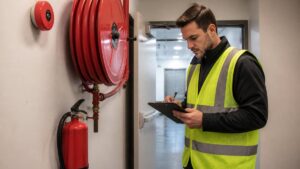
A fire equipment inspection is the systematic examination of all fire safety devices in a building to ensure they’re functional, accessible, and compliant with Australian standards. For commercial properties, it’s a legal requirement under the Building Code of Australia and state fire safety legislation.
- Fire extinguishers require monthly visual checks and annual professional servicing under AS 1851.
- Fire alarms and smoke detectors need monthly visual checks plus professional servicing every 12 months.
- Emergency lighting and exit signs must be checked monthly and professionally tested annually under AS/NZS 2293.2.
- Failed equipment must be tagged Out of Service immediately and reported to your fire safety provider.
- Inspection logs should record asset ID, location, condition, corrective actions, and next due date for audit readiness.
Table of Contents
- Fire equipment inspection checklist for commercial properties
- Fire extinguisher inspection checklist
- Fire alarm inspection checklist
- Emergency lighting and exit signage checks
- Inspection frequency and responsibility
- Fire equipment inspection log template
- Failed inspections and corrective actions
- Schedule your professional fire equipment inspection
- Frequently Asked Questions
Fire equipment inspection checklist for commercial properties
A fire equipment inspection is the systematic examination of all fire safety devices in a building to ensure they’re functional, accessible, and compliant with Australian standards.
Many facility managers treat fire equipment checks as a box-ticking exercise.
At Fyrepower, we help commercial property managers across the Gold Coast, South Brisbane, and Northern New South Wales build inspection systems that catch failures early and keep audit-ready records.
Fire extinguisher inspection checklist
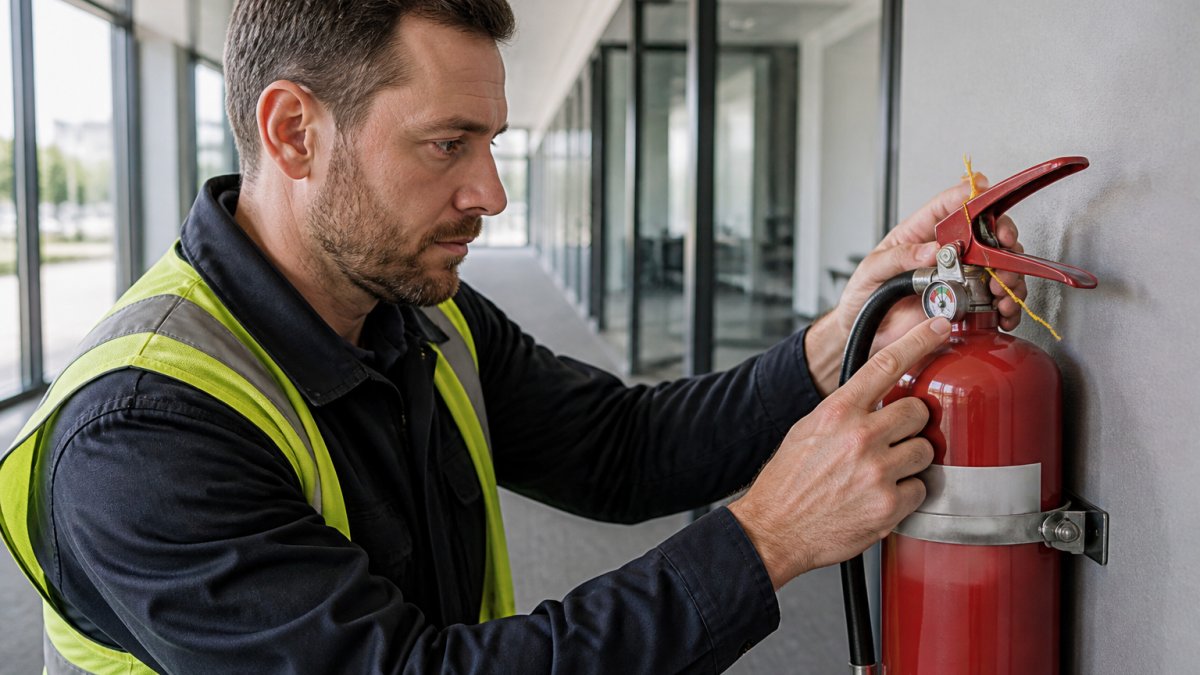
Fire extinguishers are your first line of defence, but only if they’re in working order. Visual inspections happen monthly; professional servicing is required annually under AS 1851.
What to check each month:
- Location and accessibility. Mounted between 0.8 and 1.5 metres from the floor, clearly visible, and unobstructed, nothing leaning against it or blocking the path.
- Physical condition. Check the cylinder, hose, and nozzle for dents, corrosion, rust, or damage, a damaged unit may not discharge properly.
- Pressure gauge. The needle should sit in the green zone. If it’s in the red or yellow, the extinguisher needs professional servicing immediately.
When it fails: Remove the extinguisher from service immediately, tag it “Out of Service”, and arrange professional servicing or replacement. Record every monthly check on your inspection log, even passes, consistent documentation proves diligence.
Fire alarm inspection checklist
Fire alarms and smoke detectors must function reliably. Monthly visual checks plus professional servicing under AS 1851 every 12 months keeps them operational.
What to check each month:
- Visual condition. Check for dust, debris, or damage, a cracked lens or loose casing affects performance.
- Battery indicator. Most modern alarms have a light or indicator showing battery status. It should be green or lit. If it’s red or dark, the battery needs replacement.
- Accessibility. Ensure nothing blocks the alarm, no boxes, furniture, or suspended items directly in front of it.
When it fails: Report a non-functioning alarm to your fire safety service provider immediately, don’t wait for the next scheduled service. Mark it out of service and arrange urgent repair or replacement. Professional servicing covers evacuation triggers, battery backup, and signal reach to all required zones; document the last test date and next due date.
Emergency lighting and exit signage checks
Emergency lighting and exit signs must function during a power failure. They’re the difference between an orderly evacuation and panic. Check them monthly and have them professionally tested annually under AS/NZS 2293.2.
What to check each month:
- Exit sign illumination. Walk the evacuation routes and confirm every exit sign is clearly lit and visible from a distance.
- Emergency light operation. Press the test button on each emergency light (usually located on the unit). The light should illuminate immediately. If it doesn’t, it’s faulty.
- Backup battery status. Most emergency lights have a small indicator showing battery charge. It should be green or illuminated. Red or dark means the battery is failing.
Professional testing includes a 90-minute discharge test: the power supply is cut and the system must run on battery backup for the full period. Log the result.
Inspection frequency and responsibility
Not all fire equipment needs checking at the same intervals, and not every check can be done by the same person. Build a compliant schedule by separating four tiers: routine visual checks, documented inspections, functional testing, and professional servicing, each with its own frequency, owner, and record.
The four tiers of inspection activity
| Tier | What it involves | Typical frequency | Who can do it |
|---|---|---|---|
| Routine visual check | Look, don’t touch: location, obstruction, damage, gauge position, seal integrity, sign illumination | Monthly | Trained on-site staff or facility manager |
| Documented inspection | Structured check against a written checklist, with pass/fail recorded per asset | Monthly to quarterly, depending on equipment | Trained on-site staff or facility manager |
| Functional testing | Operating test buttons, simulating alarm conditions, discharge testing emergency lights | Monthly for test buttons; periodic for system tests | Trained staff for simple tests; licensed technician for system-level tests |
| Professional servicing | Full service, pressure testing, battery load testing, system integration checks, certification | Annually (or as specified by the relevant standard and manufacturer) | Qualified fire-protection contractor |
Equipment-by-equipment schedule
| Equipment | Routine visual check | Documented inspection | Functional test | Professional service |
|---|---|---|---|---|
| Fire extinguishers | Monthly | Monthly | , | Annually under AS 1851; pressure test at the interval specified on the cylinder |
| Fire alarms and smoke detectors | Monthly | Monthly | Monthly test button; periodic system test | Annually under AS 1851 |
| Emergency lighting and exit signs | Monthly | Monthly | Monthly test button; annual 90-minute discharge test | Annually under AS/NZS 2293.2 |
| Fire doors | Monthly | Quarterly | Annual operation and latch test | Annually |
| Sprinkler systems | Weekly/monthly visual for obstruction and control-valve status | Monthly | Periodic flow test | Annually under AS 1851 |
| Fire hose reels | Monthly | Monthly | Annual flow and pressure test | Annually under AS 1851 |
| Portable fire blankets | Monthly | Monthly | , | Annually (visual and tag check) |
Frequencies above reflect common practice under AS 1851 and AS/NZS 2293.2, but the applicable interval can be tightened by the manufacturer’s instructions, the building’s fire engineering design, or a state or territory regulator. Always confirm the current requirement for your occupancy type before locking a schedule.
Who is responsible for what
The biggest cause of missed inspections is unclear ownership. Split responsibility explicitly:
- Property owner or body corporate. Accountable for compliance: approves the schedule, funds professional servicing, retains records. In strata complexes this is usually delegated in writing to a managing agent.
- Facility manager. Owns the schedule: assigns monthly checks, reviews logs, escalates failures, books servicing before due dates. Name this role in your documentation.
- On-site staff. Perform routine visual checks and documented inspections in their area. Train them on what a pass looks like and instruct them to report, not repair, defects.
Name a backup for the facility manager role. A single point of failure in the inspection schedule is as risky as a single point of failure in the equipment itself.
What on-site staff should never do
Visual checks and test-button presses are safe for trained staff. Anything involving opening a panel, discharging a system, removing a cylinder, or isolating a zone is contractor work. Staff should never remove an ‘Out of Service’ tag or return equipment to service without a documented re-test.
[PAGES_ON_THIS_SITE: Professional Fire Safety Maintenance Contract: A How-To explains how to set up a professional maintenance contract that defines inspection schedules and responsibilities.]
Fire equipment inspection log template
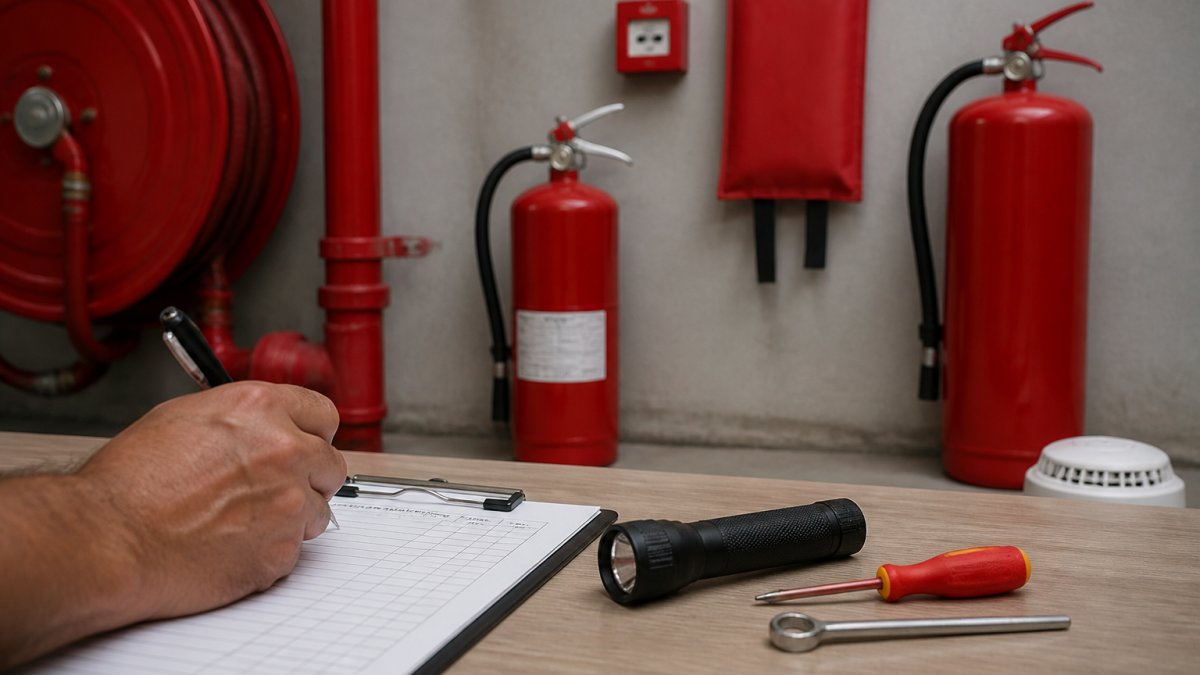
Documentation is your proof of compliance. The most useful format is a printable, record-ready sheet completed on a clipboard, then filed or digitised, not a free-text notebook.
Printable inspection log, field-by-field
Use one row per asset per inspection. The fields below are the minimum for an audit-ready record.
| Field | What to record | Example entry |
|---|---|---|
| Inspection date | Date the check was performed | 14/03/2027 |
| Inspector name | Full name of the person who performed the check | J. Nguyen |
| Equipment type | Extinguisher, alarm, emergency light, exit sign, fire door, hose reel | Extinguisher |
| Asset ID / serial | Unique identifier from the asset tag or cylinder | EXT-A1 / SN 45829 |
| Location | Building, level, room or corridor | Level 2, east corridor |
| Check performed | Which tier: visual, documented, functional, service | Visual + documented |
| Condition | Pass / fail / defect noted | Pass |
| Readings | Gauge reading, battery indicator, illumination result | Gauge 85%, seal intact |
| Defect description | Specific fault if failed | , |
| Action taken | Isolate, tag, report, repair booked | , |
| Corrective action ref | Work order or service report number | , |
| Re-test date | Date equipment returned to service after repair | , |
| Next due date | Next scheduled check or service | 14/04/2027 |
| Sign-off | Signature of inspector and reviewer | J. Nguyen / M. Patel |
Worked example entries
A vague entry like “Checked extinguishers, OK” won’t hold up in an audit. Compare these:
- Pass: “EXT-A1, Level 2 east corridor, SN 45829, gauge 85% (green), tamper seal intact, pin in place, hose free of cracks, tag current to Dec 2026. Next monthly check 14/04/2027. Signed J. Nguyen.”
- Fail: “EM-L2-03, Level 2 stairwell, test button produced no illumination. Tagged Out of Service, reported to contractor 14/03/2027, work order WO-2291. Re-test required before return to service.”
- Closure: “EM-L2-03, battery replaced by contractor 16/03/2027, 90-minute discharge test passed, returned to service. Service report SR-4471 attached. Signed M. Patel.”
Retention and audit-readiness
- Keep logs for the period required by your state or territory regulator and insurer, commonly several years, longer for professional service reports.
- Store logs for quick retrieval: a dated binder per building, or a cloud system searchable by asset ID and date.
- Keep the professional service report alongside the internal log for the same asset so the full history is in one place.
A printable log with asset ID, location, condition, corrective action reference and sign-off turns a routine check into defensible evidence. If a field isn’t filled in, assume an auditor will ask why.
Many commercial properties now use cloud-based systems that send automated reminders and flag overdue equipment, but the underlying fields should match the printable template above so records stay consistent if you switch formats.
Failed inspections and corrective actions
When something fails, your response matters as much as the discovery. An ignored failed inspection is worse than no inspection at all.
The corrective action process:
-
Identify the failure. Document exactly what failed: “Extinguisher pressure gauge in red zone” or “Emergency light test button produced no illumination.”
-
Remove from service. If the equipment is critical (an extinguisher, an alarm), tag it “Out of Service” and ensure no one relies on it.
-
Report to your service provider. Contact your fire safety provider immediately, don’t wait for the next scheduled service. Most offer urgent repair or replacement.
-
Document the corrective action. Record the date found, action taken, repair or replacement date, and who performed it. Include the invoice or service report.
-
Re-test after repair. Test repaired or replaced equipment again before returning it to service.
-
Update your inspection log. Log the failure, corrective action, and resolution date to create a complete audit trail.
Watch out: Repeated failures in the same equipment or location often signal a deeper problem. An extinguisher that keeps failing pressure checks may need replacement, not repeated servicing. Emergency lights that keep losing battery charge in one corridor may point to environmental factors or a design flaw.
Schedule your professional fire equipment inspection
Monthly visual checks and annual professional servicing keep your equipment compliant, but only if you actually do them.
[PAGES_ON_THIS_SITE: How to Select a Certified Fire Safety Inspector helps you understand how to select a qualified fire safety inspector to conduct professional inspections.]
A professional fire safety provider handles what visual checks can’t: pressure tests, battery load testing, system integration checks, and compliance certification.
Fyrepower provides comprehensive fire equipment inspection and servicing across commercial properties in the Gold Coast, South Brisbane, and Northern New South Wales.
Frequently Asked Questions
What should be included in a fire equipment inspection checklist?
A comprehensive fire equipment inspection checklist covers fire extinguishers (pressure, seals, pins, expiry dates), fire alarms and smoke detectors, emergency lighting and exit signs, fire doors and their operation, evacuation routes and accessibility, sprinkler systems, fire suppression systems, electrical hazards, and signage. Each item requires specific checks documented in an inspection log. Australian standards AS1851 and AS2444 detail the requirements for each equipment type and inspection interval.
How often should fire safety equipment be inspected?
Inspection frequency varies by equipment type. Fire extinguishers require monthly visual checks and annual professional servicing. Fire alarms and smoke detectors need testing monthly and professional certification annually. Emergency lighting and exit signs require monthly checks. Fire doors should be inspected quarterly for operation and accessibility. Sprinkler systems need annual professional inspection. Australian regulations mandate these intervals to maintain compliance and ensure equipment functions during an emergency.
What should be checked during a fire extinguisher inspection?
Check the pressure gauge to confirm it sits in the green zone, inspect the tamper seal and safety pin for integrity, look for visible dents, corrosion, or leaks on the cylinder, verify the hose and nozzle are intact and free of cracks, confirm the handle and lever operate smoothly, check that the inspection tag shows current certification, and verify the extinguisher type matches the hazards in that area. Document all findings in your inspection log for compliance records.
Who is responsible for fire safety equipment inspections in a commercial property?
Responsibility depends on the property structure. Building owners are accountable for overall compliance and ensuring inspections happen on schedule. Facility managers or property managers typically coordinate and document inspections. Body corporate managers in strata complexes are responsible for common-area equipment. Tenants may be responsible for equipment within their leased space, depending on the lease agreement. Professional fire safety providers like Fyrepower handle specialist inspections and certification to ensure compliance with Australian standards.
What records should be kept after a fire safety inspection?
Keep detailed inspection logs recording the date, equipment inspected, condition findings, pressure readings, expiry dates, any defects identified, and corrective actions taken. Retain certification tags and professional service reports from qualified inspectors. Document who performed the inspection and their credentials. Store records for at least five years to demonstrate compliance during audits. These records prove your property meets Australian fire safety standards and provide evidence of due diligence if an incident occurs.
Fire safety compliance isn’t about passing an inspection once, it’s about staying compliant consistently. Monthly checks catch obvious problems. Professional servicing catches hidden ones. Detailed documentation proves you did both. The combination keeps your property safe, your staff trained, and your insurance valid when it matters most.