Table of Contents
- Why a Fire Safety Checklist for Restaurant Kitchens Matters
- The Commercial Kitchen Fire Safety Checklist: Daily, Weekly, Monthly and Annual Tasks
- Hood, Duct and Grease Management Checks
- Fire Suppression Systems and Extinguishers: What to Check
- Your Restaurant Fire Safety Inspection Checklist for Compliance
- Fire Safety Training for Restaurant Staff
- Building a Restaurant Fire Evacuation Plan
- What to Do During a Kitchen Fire
- Frequently Asked Questions
Last Updated: October 20, 2026
Why a Fire Safety Checklist for Restaurant Kitchens Matters
A fire safety checklist for restaurant kitchens is a written, repeatable set of inspections and tasks that keeps grease, heat, fuel and ignition sources under control.
Commercial kitchens pack three fire ingredients into a small space. Heat from the commercial range and deep fryer. Fuel from overheated oil, grease buildup and packaging.
Most kitchens never get that far. A common mistake is treating the checklist as paperwork for the annual audit. It is not.
Below, we break down exactly what to check, how often, and who signs off.
The Commercial Kitchen Fire Safety Checklist: Daily, Weekly, Monthly and Annual Tasks
The commercial kitchen fire safety checklist works best when tasks are split by frequency. Daily checks catch the obvious hazards. Weekly and monthly checks catch buildup. Six-monthly and annual checks cover the systems that need a licensed technician.
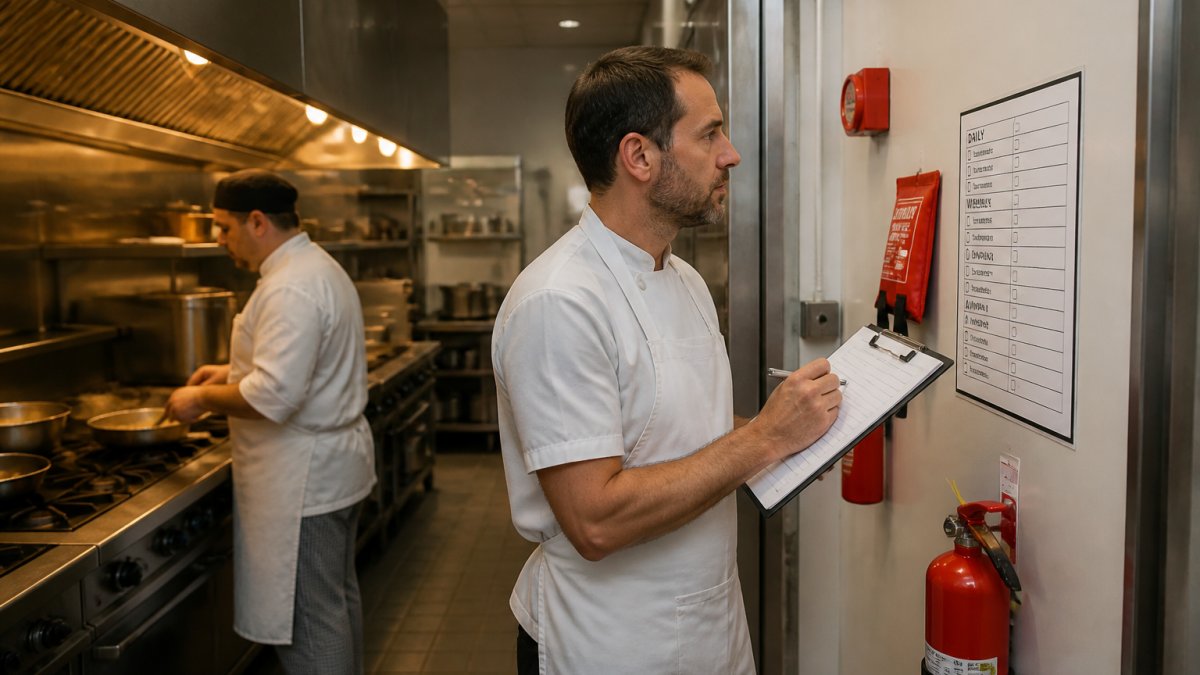
Maintaining clear pathways and functional grease traps remains as critical as monitoring heat sources, which is why kitchen drainage safety must be integrated into your routine maintenance protocols to prevent hazardous backups.
| Frequency | Key Tasks | Who Owns It |
|---|---|---|
| Daily | Clear exits, check extinguishers, clean fryer filters, wipe range surfaces | Shift supervisor |
| Weekly | Deep clean hood filters, check grease trap, inspect cords and plugs | Head chef |
| Monthly | Test extinguisher gauges, check suppression nozzles, review signage | Venue manager |
| Six-monthly | Licensed suppression system inspection, extinguisher service | Accredited technician |
| Annual | Full fire safety audit, evacuation drill, training refresh | Owner plus technician |
Daily Tasks
- Confirm all emergency exits are unlocked and clear
- Check extinguishers are in place, visible and undamaged
- Clean fryer filters and empty grease trays
- Wipe down range and grill surfaces after service
Weekly and Monthly Tasks
- Deep clean hood filters in hot soapy water
- Inspect exhaust fan for grease buildup
- Check all electrical cords for fraying or damage
- Test extinguisher pressure gauges sit in the green zone
- Confirm suppression nozzles and caps are clean and in place
Six-Monthly and Annual Tasks
- Book the six-monthly fire suppression system inspection
- Arrange extinguisher servicing per the relevant standard
- Run a full evacuation drill and record the result
- Refresh staff fire safety training
- Review the checklist itself and update owners
Australia’s fire safety framework sets the baseline here. Fire and Rescue NSW fire safety guidance and Standards Australia’s AS 1851 maintenance requirements both shape what a compliant schedule looks like.
Assign one named person to each frequency band. “Everyone” checking the fryer means nobody checks the fryer.
Hood, Duct and Grease Management Checks
Grease buildup is the number one fire hazard in a commercial kitchen. Hood filters, exhaust ducts and fans collect oil vapour every service. Left too long, that coating becomes fuel.
Check hood filters weekly and deep clean them properly. If ductwork has heavy buildup, book a professional hood cleaning before the next busy period. Keep a written cleaning schedule so nothing slips.
- Check hood filters weekly, clean or replace as needed
- Inspect exhaust duct and fan monthly
- Schedule professional duct cleaning based on cooking volume
- Log every clean with date and initials
Fire Suppression Systems and Extinguishers: What to Check
A fire suppression system is an automatic extinguishing system that discharges wet chemical agent onto cooking equipment when a fire is detected. It is your first line of defence over the range and fryer, and it only works if it is inspected, serviced and unobstructed.
Suppression system checks
Split suppression checks into what staff can see and what only a licensed technician should touch.
Staff-visible checks (daily to monthly):
- Nozzle caps present, clean and pointed at the cooking surface
- No cooking equipment moved since the last service (a relocated range can leave nozzles aimed at the wrong spot)
- Manual pull station visible, unobstructed and undamaged
- Inspection tag present and in date
- Agent cylinder gauge showing normal pressure
Technician-only checks (six-monthly and annual):
- Full system inspection and test by an accredited technician
- Fuel and power shutoff verification during test
- Cylinder pressure and agent condition
- Pipework and nozzle alignment
- Service report issued with defects and corrective actions
A common pattern is to treat the six-monthly service as the only suppression task. That misses the daily nozzle and pull-station checks that catch problems between services. Keep a simple log so the technician can see what staff have already flagged.
Extinguisher types and placement
Match the extinguisher to the fire risk, not to whatever is on special.
- Wet chemical, the correct choice for cooking oil and fat fires on the cooking line; mount one within easy reach of the range and fryer
- Dry chemical, general standby for electrical and flammable liquid risks; keep on brackets, clearly signed
- Fire blanket, for small pan fires; store beside the cooking line
Placement rules that matter in practice:
- Mount on brackets at a reachable height, not on the floor
- Keep the area in front clear, nothing stacked, no trolleys parked
- Sign each location so staff can find it in smoke
- Do not block access with stock or cleaning equipment
Extinguisher inspection and servicing
Staff should check extinguishers monthly: gauge in the green zone, pin and seal intact, no dents or corrosion, tag in date, access clear. Record the check with date and initials.
Servicing is a technician task. Book it per the relevant standard and keep the service record with your other compliance documents. An extinguisher that has been discharged, even partially, needs professional attention before it goes back on the wall.
Failure signs that need immediate action
Call a licensed technician immediately if you see:
- Nozzle caps missing, blocked or greasy
- Inspection tag out of date or missing
- Fuel supply not shutting off during a test
- Manual pull station damaged or obstructed
- Agent cylinder showing low pressure
Do not wait for the next scheduled visit. A suppression system with a known defect is not a suppression system.
Never place stock or equipment in front of a suppression manual pull station. In a fire, seconds matter and a blocked station can cost you the whole kitchen.
Photograph the suppression tag and extinguisher gauges during your monthly check and file the images with the log. It is a quick way to prove condition between services.
Your Restaurant Fire Safety Inspection Checklist for Compliance
The restaurant fire safety inspection checklist should mirror what an auditor will ask for. That means records, not just actions.
For compliance, keep documentation for:
- Suppression system inspection reports
- Extinguisher service records
- Hood and duct cleaning logs
- Staff training attendance
- Evacuation drill records
Vague reports that cannot prove the work was done are a common audit failure point. Our QBSA-licensed and fully insured team documents every inspection so your records hold up.
Check the Safe Work Australia fire safety resources for general workplace obligations, and confirm local requirements with your council or fire service.
Fire Safety Training for Restaurant Staff
Fire safety training for restaurant staff is not a box-ticking exercise. It is the difference between a staff member calmly shutting off the gas and one who panics.
Train every role differently:
- Chefs – suppression system operation, fuel shutoff, fryer fire response
- Front of house – evacuation leadership, extinguisher use, calling emergency services
- Managers – checklist ownership, recordkeeping, drill coordination
New employees need induction training before their first shift on the line. Refresh all staff annually and after any near miss.
The best-trained kitchens respond to small fires in seconds. Untrained kitchens lose minutes they do not have.
Building a Restaurant Fire Evacuation Plan
A restaurant fire evacuation plan maps how staff and diners get out safely. It needs clear escape routes, marked exits, a meeting point and named people who own each step. The plan that works is the one staff have practised, not the one pinned to the wall.
What the plan must cover
- Clearly marked emergency exits, kept unlocked during service
- A primary and secondary escape route from the kitchen and dining area
- A designated roll-call point away from the building
- Assigned staff roles for guiding diners out, checking toilets and back-of-house areas, and accounting for staff
- A clear trigger for calling emergency services
Role assignments
Generic plans fail because nobody knows who does what. Assign named roles and backups:
- Shift supervisor, raises the alarm, confirms emergency services are called, takes the roll call at the meeting point
- Head chef, shuts off gas and fuel supply if safe, confirms the cooking line is isolated
- Front of house lead, directs diners to the nearest safe exit, checks toilets and function rooms
- Second staff member, sweeps back-of-house areas and confirms all staff are out
Write the names on the plan and update them when rosters change. A plan with last year’s names is a plan nobody follows.
Drill mechanics
Run drills at least annually, and more often for new teams. A drill that is announced in advance tests the plan; an unannounced drill tests the staff. Do both over time.
During a drill:
- Time the evacuation from alarm to roll call
- Note bottlenecks, blocked exits and confusion points
- Check that the roll call accounts for every person on shift
- Record the result, including what needs fixing
If it takes too long, fix the plan, not the drill.
Recordkeeping
Keep a simple evacuation record: date, time, who ran it, evacuation time, issues found and corrective actions. Auditors and insurers ask for evidence, and a written record turns a good intention into a defensible process.
A plan without named roles and a drill record is a document, not a procedure. Assign, practise and record.
What to Do During a Kitchen Fire
A kitchen fire rewards speed and the right action. Get it wrong and a small flare becomes a full emergency.
For a pan or fryer fire:
- Turn off the heat and fuel supply if safe to reach
- Cover the pan with a fire blanket or lid to smother flames
- Activate the suppression system if fire is on the cooking line
- Evacuate and call emergency services if the fire spreads
- Never use water on an oil or grease fire
Water on burning oil causes violent flare-up. This is the single most dangerous mistake in a kitchen fire.
Never move a burning pan. Carrying it spreads fire and causes serious burns. Smother it where it sits.
A kitchen fire can start in the time it takes to plate a dish. The venues that stay open are the ones with a real checklist, trained staff and properly maintained suppression systems.
Frequently Asked Questions
What should be included in a restaurant kitchen fire safety checklist?
A working fire safety checklist covers hood and duct cleaning records, suppression system inspection tags, extinguisher placement and pressure, clearances around cooking equipment, gas shutoff access, electrical lead condition, and safe storage of oils and flammable waste. It should also record staff training dates and evacuation drills. Each item needs a frequency, an owner and a sign-off so you can prove the work was done during an audit or insurance review.
How often should restaurant fire safety equipment be checked?
Extinguishers need a visual monthly inspection and a professional service every six months under AS 1851. Fire suppression systems and hood cleaning follow the same six-monthly rhythm in most commercial kitchens, though heavy-grease operations may need quarterly hood cleaning. Exit signs, emergency lighting and evacuation diagrams should be checked monthly and tested annually. Keep every inspection tag and service report on file.
What fire suppression system does a commercial kitchen need?
Most commercial kitchens need a wet chemical automatic extinguishing system covering cooking equipment, plenum and exhaust duct, with manual pull stations at the exit. The system must be installed to AS 3772 and serviced to AS 1851 by a competent person. Fuel shutoff must trigger automatically when the system discharges. Confirm your system covers every appliance under the hood, including deep fryers and solid-fuel equipment if present.
What should kitchen staff do if a fire starts?
Raise the alarm, call triple zero, and evacuate to the assembly area. If a pan or fryer fire is small and safe to approach, turn off the heat and activate the manual pull station, then leave. Never throw water on an oil fire and never move a burning pan. Close doors behind you to slow smoke spread. Staff should only attempt to fight a fire if trained, confident and with a clear escape route behind them.