Table of Contents
- Wet Pipe vs Dry Pipe Sprinkler Systems: Quick Comparison
- How a Wet Pipe Sprinkler System Works
- How a Dry Pipe Sprinkler System Works
- Fire Sprinkler System Types and When to Use Each
- Installation, Maintenance, and Lifecycle Costs
- Freeze Protection, Water Damage, and Building Code Requirements
- Which System Should You Choose?
- Frequently Asked Questions
Last Updated: October 16, 2026
Wet Pipe vs Dry Pipe Sprinkler Systems: Quick Comparison
Understanding wet pipe vs dry pipe sprinkler systems affects how fast water reaches a fire, your installation costs, and whether your pipes freeze in winter. At Fyrepower, we help property managers across the Gold Coast and Northern New South Wales choose the right system. Both deliver water when heat triggers a sprinkler head, but the path water takes, and when it arrives, separates them.
A wet pipe sprinkler system keeps water in the pipes at all times, ready to discharge the moment a sprinkler head opens. A dry pipe sprinkler system stores pressurised air or nitrogen in the pipes instead, releasing water only after the dry pipe valve opens. The choice hinges on three factors: climate, building use, and how quickly you need water on the fire.
Comparison Table
| Factor | Wet Pipe System | Dry Pipe System |
|---|---|---|
| Pipes contain | Water under pressure | Pressurised air or nitrogen |
| Water delivery time | Immediate (fastest) | Delayed (slower) |
| Installation cost | Lower | Higher |
| Maintenance complexity | Simpler | More complex |
| Freeze protection | Not suitable for unheated spaces | Designed for freezing conditions |
| Best for | Heated buildings, rapid response | Cold climates, unheated warehouses |
| Building types | Offices, retail, apartments | Parking garages, loading docks, storage |
How a Wet Pipe Sprinkler System Works
Water sits in every metre of piping throughout a wet pipe system, held under pressure by a supply line connected to your building’s main. When heat melts the solder on a sprinkler head, that head opens instantly and water flows directly out, with no delay. Fewer components mean fewer things that can fail.
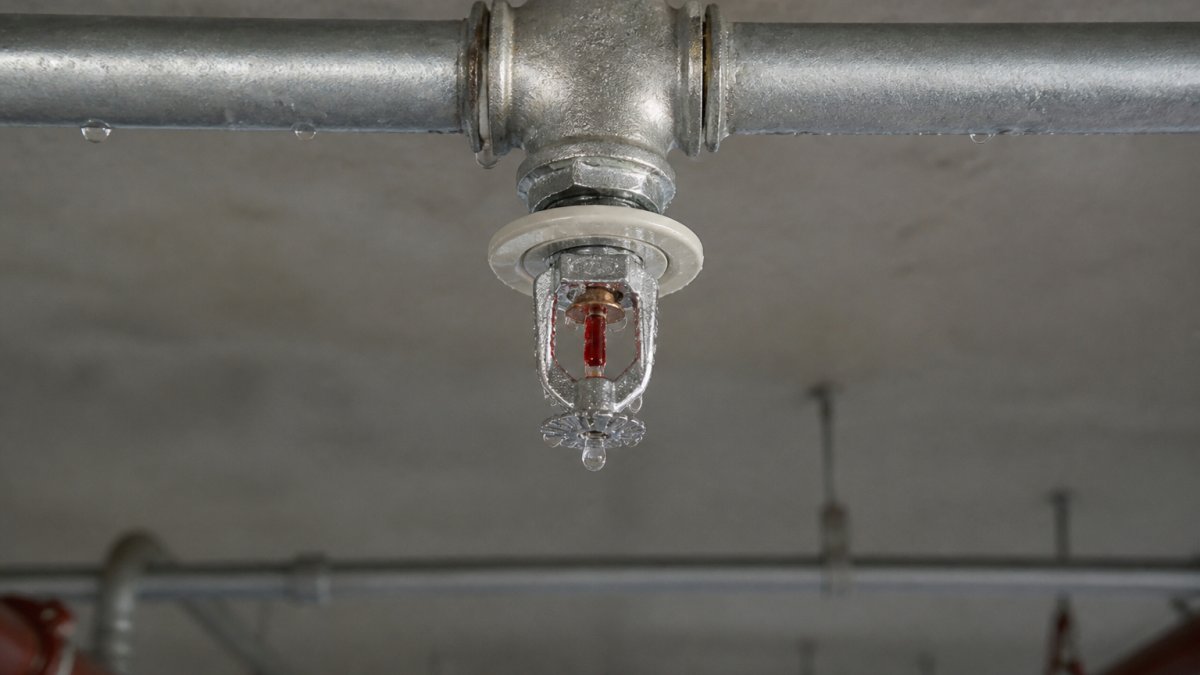
Because water is already in the pipes, discharge begins within seconds of activation, and those first seconds are critical for fires spreading rapidly through a room. This immediate response is why wet pipe systems remain the standard in most heated commercial buildings, offices, and residential properties.
The trade-off is obvious: water expands as it freezes, and frozen pipes burst, rendering the system useless exactly when you need it most. Wet pipe systems require heated spaces, sprinkler rooms, service corridors, and all piping above freezing. In unheated zones (parking garages, loading docks, external storage), water in the pipes becomes a liability.
How a Dry Pipe Sprinkler System Works
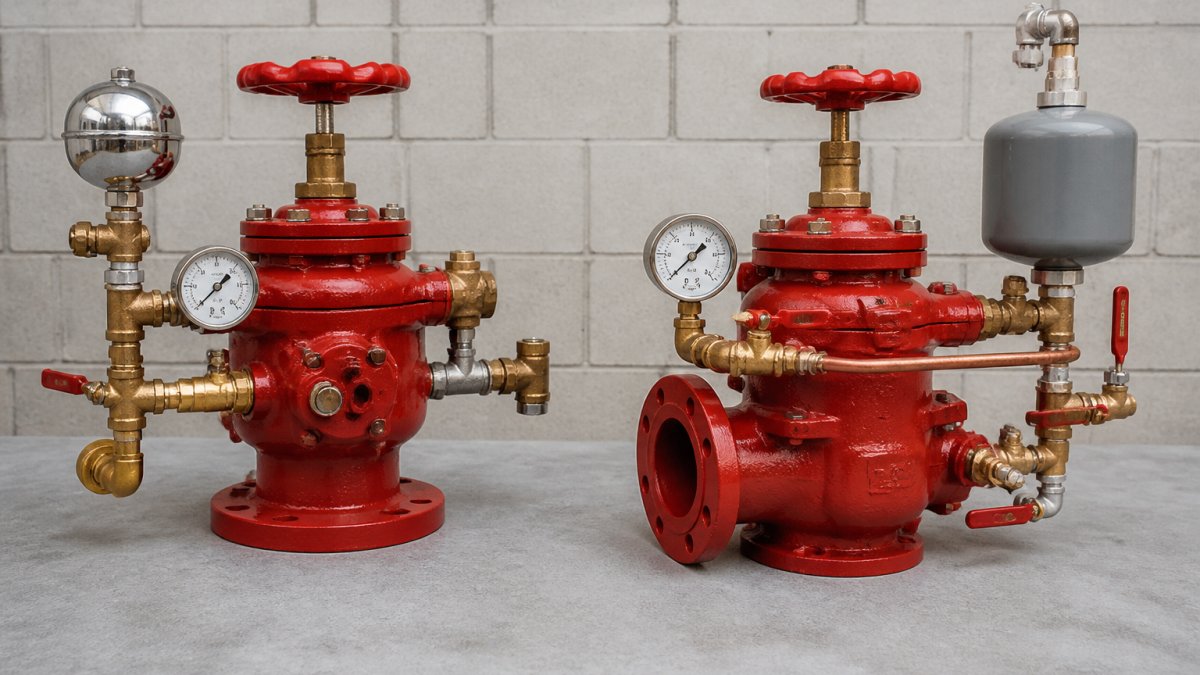
Instead of water, a dry pipe system pressurises the pipes with air or nitrogen gas. When a sprinkler head opens, that pressure drops, triggering the dry pipe valve, which opens a water supply line. Water then travels to the open head, typically arriving 30 to 60 seconds after activation, depending on pipe length and system design.
This delay exists because water must travel from the valve to the furthest sprinkler heads, a longer journey in a large warehouse. Dry pipe systems are therefore not ideal where rapid fire spread is a concern, but they excel where freeze protection is non-negotiable.
The system’s complexity is the cost. More components, the dry pipe valve, air compressor, pressure gauges, and inspection ports, mean more maintenance, and annual testing is essential. The pipes must stay dry, which requires regular checks for leaks that could introduce water where it should not be.
Dry pipe systems suit unheated buildings, cold-storage facilities, and climates where winter temperatures drop below freezing. They’re standard in parking structures, external loading areas, and warehouses without climate control. In these settings, the delayed water delivery is acceptable because the building layout and fire load allow for it.
Fire Sprinkler System Types and When to Use Each
Beyond wet and dry systems, fire protection specialists recognise several other configurations. Understanding when each applies helps you avoid over-specifying (paying for features you don’t need) or under-specifying (choosing a system that won’t meet your building’s risk profile).
Wet pipe systems dominate heated buildings where rapid response is the priority: offices, retail spaces, apartment buildings, and hospitals almost always use wet pipe. Installation is straightforward, maintenance is routine, and response time is unmatched.
Dry pipe systems are essential in unheated or partially unheated buildings. Parking garages, warehouses, loading docks, and storage facilities in cold climates depend on dry pipe to avoid frozen pipe failures. Response time is slower, but a system that works beats one that fails silently when pipes freeze. Maintaining consistent ambient temperatures remains a critical strategy for preventing frozen pipes in regions where sudden cold snaps can overwhelm even the most robust fire protection infrastructure.
Pre-Action and Deluge Systems
Pre-action systems add a layer of protection against accidental discharge. Before water enters the piping, a separate fire detection system (smoke detector or heat sensor) must trigger first; only then does water enter the pipes, so when a sprinkler head opens, water discharges immediately. Used in data centres, archives, and museums where water damage from a false alarm could be catastrophic, they’re more expensive and complex, but the protection justifies the cost.
Deluge systems take the opposite approach: when activated, all sprinkler heads open simultaneously, flooding the entire area with water. Used in high-hazard industrial settings, chemical storage, aircraft hangars, or manufacturing facilities with extreme fire risk, they are overkill for a standard office or retail space, but where fire can spread explosively, simultaneous discharge from every head is essential.
Installation, Maintenance, and Lifecycle Costs
Most comparisons stop at “wet is cheaper to install, dry is costlier to maintain.” That is true as far as it goes, but not enough to budget from. The table below breaks the cost picture into the components that drive the difference.
| Cost area | Wet pipe system | Dry pipe system |
|---|---|---|
| Core pipework and sprinkler heads | Comparable | Comparable |
| Valve assembly | Simple alarm/check valve | Dry pipe valve, air compressor, pressure regulators, gauges |
| Air or nitrogen supply | Not required | Compressor, dryer, and controls (capital and running cost) |
| Freeze protection | Building heating must be maintained | No heating required in protected spaces |
| Routine inspection | Annual | Annual plus more frequent air-pressure and valve checks |
| Trip testing | Not applicable | Periodic dry pipe valve trip test (typically annual) |
| Corrosion management | Water-filled; internal corrosion possible | Trapped moisture and oxygen can accelerate corrosion if not managed |
| Likely repair profile | Leaks, sediment flushing | Valve rebuilds, compressor service, gauge replacement |
Upfront installation. The wet pipe system’s advantage is component count: piping, heads, and a straightforward water supply connection. A dry pipe system adds the dry pipe valve assembly, an air compressor (often with a dryer), pressure regulators, and instrumentation, each carrying supply, installation, and commissioning costs plus space in a valve room. The premium is real, but it is a one-off.
Ongoing maintenance. Wet pipe systems generally need annual inspection and occasional flushing to clear sediment. Dry pipe systems need all of that plus air-pressure monitoring, compressor servicing, and periodic dry pipe valve trip testing. The gap widens with system age, because compressors and valves have service lives and rebuild intervals that wet systems do not.
The hidden cost of getting it wrong. The lifecycle comparison only holds if each system is used where it belongs. A wet pipe system in an unheated space invites freeze damage, burst pipes, water damage, and emergency repairs, which can dwarf any installation saving. A dry pipe system in a heated office adds capital and maintenance complexity for freeze protection the building does not need. The cheapest system over 10 to 15 years is the one correctly matched to the space.
Budget for the whole system, not just the pipe. Wet pipe usually wins on total cost of ownership in heated buildings; dry pipe’s higher capital and maintenance cost is the price of reliable protection in unheated or freezing spaces.
Fyrepower provides maintenance and testing for both system types, with scheduling and service records aligned to AS 1851 so inspection, trip testing, and documentation satisfy audit requirements. For property managers running multiple buildings, consolidating testing and record-keeping with one provider reduces administrative load and helps ensure no scheduled check is missed.
Freeze Protection, Water Damage, and Building Code Requirements
The temperature trigger. Water expands as it freezes, and the expansion cracks pipes and fittings. Risk is highest in unheated or intermittently heated spaces: parking garages, loading docks, external storage, attics, plant rooms, and any pipe route through a cold zone.
How dry pipe removes the risk. Because the pipes hold air or nitrogen rather than water, there is nothing in the piping to freeze. Water is held back at the dry pipe valve and enters the piping only after the valve trips.
Water damage and corrosion. The inverse concern is water where it is not wanted. A wet pipe system carries a small but real risk of accidental discharge, leaks, or joint failures, and in high-value spaces even a modest leak can cause significant loss.
Code and standard requirements. In Australia, the National Construction Code sets the overarching fire safety framework, AS 2118 (automatic fire sprinkler systems) provides detailed design and installation requirements, and AS 1851 governs inspection, testing, and maintenance.
Mixed-temperature buildings. Many real buildings are not uniformly heated: a single facility may have a heated office and an unheated loading dock, or a warm retail floor above a cold parking level.
Map the temperature profile of every space the sprinkler system serves before choosing a type. The zones that cannot be guaranteed above freezing are the ones that decide whether you need dry pipe, and where a hybrid boundary should sit.
Fyrepower reviews building classification, climate exposure, and space-by-space temperature conditions against AS 2118 and AS 1851 to recommend a system that satisfies the standard and performs in service, including hybrid layouts for buildings with both warm and cold zones.
Which System Should You Choose?
Start with climate and building use. If your building is heated year-round and you want the fastest possible response time, wet pipe is the clear choice: simpler installation, straightforward maintenance, and water reaching the fire within seconds of sprinkler activation.
If your building includes unheated zones, parking structures, loading docks, storage areas, or sits in a region where winter temperatures drop below freezing, dry pipe becomes necessary.
For high-value environments where accidental discharge poses a real risk, data centres, archives, museums, a pre-action system adds protection that justifies the additional cost and complexity.
The decision isn’t just technical; it’s about matching the system to your building’s actual risk profile and operational environment. Choosing wet pipe for an unheated parking garage is a serious risk, while specifying dry pipe for a heated office adds unnecessary cost and complexity.
At Fyrepower, we help property managers and body corporate managers make this choice by reviewing your building layout, climate, use case, and code requirements. Our fully insured and QBSA-licensed team provides recommendations backed by Australian safety standards and handles all ongoing maintenance and compliance testing.
Fire protection isn’t a set-and-forget investment. Whether you’ve chosen wet pipe, dry pipe, or a hybrid approach, your system requires regular testing, inspection, and maintenance to remain compliant and functional. At Fyrepower, we specialise in keeping fire safety systems reliable across the Gold Coast, South Brisbane, and Northern New South Wales.
Frequently Asked Questions
What is the main difference between a wet pipe and dry pipe sprinkler system?
A wet pipe sprinkler system keeps water in the pipes at all times, so water discharges immediately when a sprinkler head activates. A dry pipe system uses pressurised air or nitrogen instead of water, delaying water delivery until the dry pipe valve opens. Wet systems offer faster response times and lower installation costs; dry systems protect against frozen pipes in unheated spaces.
When should a building use a dry pipe sprinkler system?
Use a dry pipe sprinkler system in unheated spaces, cold storage areas, car parks, or any building exposed to freezing temperatures where water-filled piping could freeze and burst. They are essential in cold climates or buildings with temperature-controlled environments that cannot maintain above-freezing conditions year-round. Dry systems prevent water damage and system failure in these high-risk situations.
Are wet pipe sprinkler systems more reliable than dry pipe systems?
Wet pipe systems are simpler in design with fewer components, making them generally more reliable and easier to maintain. However, reliability depends on your building’s conditions. Wet systems excel in heated spaces but fail in freezing temperatures. Dry pipe systems are equally reliable in cold climates but have more complex mechanisms and slightly longer response times. Choose based on your building’s environment and requirements.
What are the benefits of a wet pipe sprinkler system?
Wet pipe systems offer immediate water discharge, faster fire suppression response, simpler design requiring fewer components, lower installation and maintenance costs, and greater reliability in standard commercial and residential buildings. They are cost-effective for heated spaces and require less complex testing and inspection schedules compared to dry systems.