Last Updated: November 18, 2026
Quick Summary
Strata fire safety records should be kept for the life of the measure they cover, plus a buffer. Retention periods depend on the record type and the state or territory, so the owners corporation should adopt a written schedule. Keep annual fire safety statements and their supporting inspection reports together as one file.
- Retention runs from the date of the record, not the date it was filed.
- Keep full service reports for every inspection, not just the invoices.
- Set retention at the longest applicable requirement plus a buffer.
- Keep each year’s annual fire safety statement as a self-contained folder.
- Hand over the full file, the register and open defects when managers change.
Table of Contents
- Why Fire Safety Records Matter for Strata Schemes
- Who Is Responsible for Keeping Fire Safety Records
- Fire Safety Inspection Records: What to Keep and For How Long
- Annual Fire Safety Statement Strata Requirements and Retention
- Building a Strata Fire Safety Compliance Checklist
- Setting Up a Strata Fire Safety Register Template
- Storing Records, Handling Building-Manager Transitions and Next Steps for Your Scheme
- Frequently Asked Questions
Why Fire Safety Records Matter for Strata Schemes
Strata fire safety records are the proof that a building’s fire protection systems were inspected, tested and maintained as required. Without them, an owners corporation cannot show it met its obligations.
Retention depends on the type of record and the state or territory the building sits in. Many committees keep everything indefinitely, which is safe but untidy. Others throw out records too early and then struggle to prove work was done during an audit.
Records matter for three practical reasons:
- Compliance checks: councils and fire authorities may ask for evidence of past inspections.
- Insurance and claims: a fire incident often leads to questions about whether maintenance was up to date.
- Handovers: a new strata manager or committee needs a clear history to pick up where the last one left off.
NSW Department of Customer Service fire safety guidance
Who Is Responsible for Keeping Fire Safety Records
The owners corporation holds the legal responsibility for common property fire safety. In practice, it usually delegates the day-to-day record keeping to a strata manager, with the strata committee overseeing the process.
A simple split of responsibilities works well:
- Owners corporation: accountable for compliance and decisions about maintenance.
- Strata manager: collects, files and tracks service reports and certificates.
- Strata committee: reviews records at meetings and approves recommended works.
- Contractors: provide service reports and certificates for each visit.
Get written confirmation of who holds the master copy of each record. Confusion over that point is a common cause of lost documents when managers change.
Fire Safety Inspection Records: What to Keep and For How Long
Inspection and maintenance records are the core of any fire safety file. They show what was checked, when, by whom, and what was found.

Most ranking guides stop at ‘keep your inspection reports’. That is not enough for a retention query. Keeping records that show how fire-safety decisions were made can also help a scheme assess its strata maintenance insurance requirements when an audit, claim or dispute arises.
Statutory minimums versus prudent retention
Statutory minimums can come from several places at once, and they are not interchangeable:
- Fire safety law: the obligation to maintain essential fire safety measures and to lodge an annual statement creates the duty to hold the supporting evidence behind each statement.
- Strata records rules: owners corporations must keep certain records, including minutes, financial records and correspondence, for set periods under state strata legislation.
- Building and development approvals: conditions of consent and occupation certificates can impose their own record-keeping expectations.
- Standards: fire protection standards set the servicing and maintenance regime for fire protection systems, and inspection reports and test certificates are the evidence that the regime was followed.
- Insurer requirements: policies commonly require maintenance records to be produced after an incident, and the insurer’s retention expectation may exceed the statutory floor.
Because these sources overlap, a scheme that keeps only the statutory minimum can still be exposed. A common pattern is to set the retention period at the longest applicable requirement plus a buffer, and to document that decision in a retention schedule approved by the owners corporation.
A practical retention schedule by document type
Use this as a starting point, then confirm the current periods for your state or territory before adopting it. Periods differ between jurisdictions, and a schedule copied from another state is a common source of error.
| Record type | Minimum to hold | Prudent retention |
|---|---|---|
| Inspection and service reports (AS 1851) | Life of the measure, per state requirements | Life of the measure plus 7 years |
| Annual Fire Safety Statements and lodgement confirmations | All current and prior statements | Life of the building |
| Defect notices and corrective action records | Until closure is documented, then statutory period | 7 years after closure |
| Incident and fire damage reports | Statutory period | 15 years, or life of the building for serious incidents |
| Contractor licences and insurance certificates | Current versions | 7 years after the contractor’s last visit |
| Invoices, quotes and payment records | Financial record period under strata law | 7 years |
| Committee minutes dealing with fire safety | Statutory period for minutes | Life of the building |
| Correspondence with council or fire authority | Statutory period | 7 years |
Two rules make the table work in practice. First, retention runs from the date of the record, not the date it was filed, a report discovered late still has to be kept for its full period. Second, ‘life of the measure’ means until the equipment is decommissioned or replaced, so replacement records should be linked to the records they supersede rather than filed separately.
Watch out: destroying reports on a rolling calendar without checking whether a defect, claim or dispute is still open can leave the scheme unable to prove the work was done.
Queensland Fire and Emergency Services fire safety information
Annual Fire Safety Statement Strata Requirements and Retention
An annual fire safety statement, often called an AFSS, confirms that the essential fire safety measures in a building have been inspected and maintained and that they are performing to the standard required. For strata schemes that must lodge a statement, the AFSS is the headline document, but it is only defensible if the evidence behind it is retained with it.
What the statement actually certifies
The AFSS is a point-in-time certification, not a maintenance regime. It typically identifies each essential fire safety measure in the building, the standard each measure must meet, and confirmation that each has been assessed by a competent person. The assessment is only as good as the inspection reports that support it, which is why the statement and its supporting evidence should be treated as one record set rather than two.
Retention rules for AFSS records
- Keep the lodged statement and the council or fire authority confirmation of lodgement together.
- Keep the inspection reports that support each measure listed on the statement, cross-referenced to the measure name.
- Keep a record of any measure that failed assessment and how and when it was rectified.
- Keep statements for prior years so the scheme can show a continuous compliance history.
- Keep the competent person’s details, licence or accreditation and insurance certificate for each statement.
A useful discipline is to file each year’s AFSS as a self-contained folder: the statement, the lodgement confirmation, the supporting reports, the rectification evidence and the contractor details. That folder then becomes the unit of retention, which makes audits and handovers far simpler than a year-by-year pile of mixed documents.
Storage, access and handover
Retention only works if the records can be produced. A few practical controls close the gap:
- One master location: nominate a single secure digital repository as the master copy, with physical originals stored in a locked cabinet and indexed to the digital file.
- Folder structure by year and measure: name folders so a new manager can find a report without asking. Year, then measure, then document type is a structure most committees find intuitive.
- Access permissions: give edit rights to a small number of people, typically the strata manager and one committee office-bearer, and read access to the committee. Owners should be able to request access to records under strata law without needing edit rights.
- Backups: keep an off-site or cloud backup, and test that it restores. A backup nobody has restored is an assumption, not a control.
- Handover pack: when a strata manager or building manager changes, hand over the full file, the fire safety register, a list of open defects and a written confirmation of what was transferred. Ask the outgoing manager to sign that confirmation.
Watch out: if the master copy sits in a departing manager’s personal drive or inbox, the scheme can lose years of evidence in a single handover.
NSW Department of Customer Service fire safety guidance
Building a Strata Fire Safety Compliance Checklist
A checklist keeps the file complete and makes audits less stressful. Use it as the first thing you check before any inspection visit.
- Current Annual Fire Safety Statement and council confirmation
- Service reports for each essential fire safety measure, dated and signed
- Exit light and emergency lighting test records
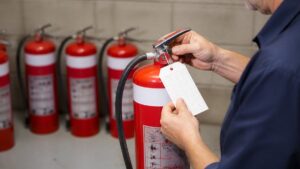
- Fire extinguisher service tags and inspection logs
- Fire door and smoke alarm inspection records
- Sprinkler and hydrant test certificates, where installed
- Defect notices with proof of corrective action
- Contractor licence and insurance details on file
- Committee minutes showing fire safety items were reviewed
- Records retention schedule approved by the owners corporation
Review this list before each committee meeting. Gaps are much easier to fix when they are spotted early.
Setting Up a Strata Fire Safety Register Template
A fire safety register is a single list that tracks every inspection and certificate. It shows at a glance what is current, what is due and what is overdue.
A simple register needs these columns:
| Equipment or measure | Location | Last inspected | Next due | Contractor | Report filed at |
|---|---|---|---|---|---|
| Fire extinguishers | Levels 1 to 4 | Date | Date | Name | File link |
| Exit lights | Stairwells | Date | Date | Name | File link |
| Fire doors | Corridors | Date | Date | Name | File link |
| Smoke alarms | Common areas | Date | Date | Name | File link |
Keep the register in a shared folder that the committee can access. Update it the same day an inspection report arrives, and note any defects that need follow-up.
Storing Records, Handling Building-Manager Transitions and Next Steps for Your Scheme
Records are only useful if people can find them. Store them in one shared location with clear folder names by year and by measure. Limit edit access to a small number of people, and keep a backup copy.
When a building manager or strata manager changes, hand over the full file, the register and a list of any open defects. Ask the outgoing manager to confirm in writing what has been handed over.
Start with a records audit. Check which reports are missing, which dates are overdue and who holds each master copy.
Frequently Asked Questions
How long should strata fire safety records be retained?
Retention periods depend on the record type and the rules that apply in your state or territory. Records that show a fire safety obligation was met, such as inspection and maintenance reports, should be kept for as long as they remain relevant to the building, and at minimum for the period set by the relevant state regulation. Because requirements differ across Australian jurisdictions, confirm the exact periods with your local council or fire authority, and keep records for the longest period that applies to your scheme. When in doubt, retain records longer rather than discarding them early.
Who is responsible for keeping fire safety records in a strata scheme?
The owners corporation, or body corporate, is generally responsible for maintaining fire safety records for common property, and it usually delegates day-to-day record keeping to the strata manager. The strata committee oversees that the records are complete and accessible. Whoever holds the records should be able to produce them quickly during an audit, a council inquiry or a building-manager handover, so responsibilities should be written into the strata management agreement.
Do strata buildings need to keep annual fire safety statements?
Yes, where a building is required to lodge an Annual Fire Safety Statement with the local council, the owners corporation should keep a copy of each statement along with the supporting inspection and maintenance evidence. Keeping the statements on file lets the scheme demonstrate that its essential fire safety measures were certified and that lodgement deadlines were met. Requirements vary by state, so check the obligations that apply to your building.
What should a strata fire safety compliance register include?
A practical strata fire safety register should list each essential fire safety measure, the date and type of each inspection or service, the name of the service provider, the outcome, any defects raised and the corrective action taken, plus the date of the next due service. Store the register alongside the underlying service reports so an auditor can trace each entry back to evidence. Updating it after every visit keeps the scheme ready for audit at any time.