Quick Summary
Emergency lighting for retail stores must light exit paths at floor level, switch on automatically when mains power fails, and keep working for a minimum period after power loss. The core rules sit mainly in AS/NZS 2293.1, called up through the National Construction Code. Coverage follows the building’s exit routes, including back-of-house areas.
- Exit paths need enough light at floor level for safe movement during an outage.
- The system must switch on automatically when mains power fails.
- Six-monthly functional checks and annual full duration tests are required.
- Exit signs must not be blocked by stock, shelving or promotional banners.
- Every test must be recorded unit by unit in a logbook kept on site.
Table of Contents
- Emergency Lighting Requirements for Retail: The Core Rules
- Which Retail Areas Need Emergency Lighting and Exit Signs
- Emergency Lighting Duration Requirements Under AS/NZS 2293
- Emergency Exit Sign Requirements for Retail Premises
- Emergency Lighting Testing Requirements: Six-Monthly and Annual
- Emergency Lighting Inspection Checklist for Store Managers
- Booking a Compliance Check for Your Gold Coast Store
- Frequently Asked Questions
Emergency Lighting Requirements for Retail: The Core Rules
Emergency lighting is the part of a retail fit-out that works only when everything else has failed. A power cut, a fire alarm or a crowded shop floor all depend on it. Under Australian rules, the requirements are specific, and inspectors check them closely.
Last Updated: November 4, 2026
The same questions come up on almost every retail site visit. This guide sets out the core rules, the areas that need coverage, and what store managers must check and record.
Emergency lighting must give enough light for people to find their way out. In practice, that means lighting along exit paths that stays on for a set time after mains power is lost. The rules sit mainly in AS/NZS 2293.1 Emergency escape lighting and exit signs for buildings and are called up through the National Construction Code.
Three core rules apply to most retail stores:
- Illumination: Exit paths need enough light at floor level for safe movement.
- Activation: The system must switch on automatically when mains power fails.
- Duration: Lights must keep working for a minimum period after power loss.
Each rule is covered in more detail below, starting with the areas that need coverage.
Which Retail Areas Need Emergency Lighting and Exit Signs
Coverage follows the building’s exit routes, not just the shop floor. Any space a customer or staff member passes through on the way out needs lighting, and in retail the exit route is constantly being rearranged by merchandising. Most retail premises need emergency lighting in:
- The main sales floor and aisles
- Exit corridors and passageways to the outside
- Stairwells and fire-isolated stairways
- Storerooms and back-of-house routes that lead to an exit
- Toilets and amenities opening onto an exit route
- Checkout zones and service counters that sit on an exit path
- Stockrooms, cool rooms and loading docks with a travel path to an exit
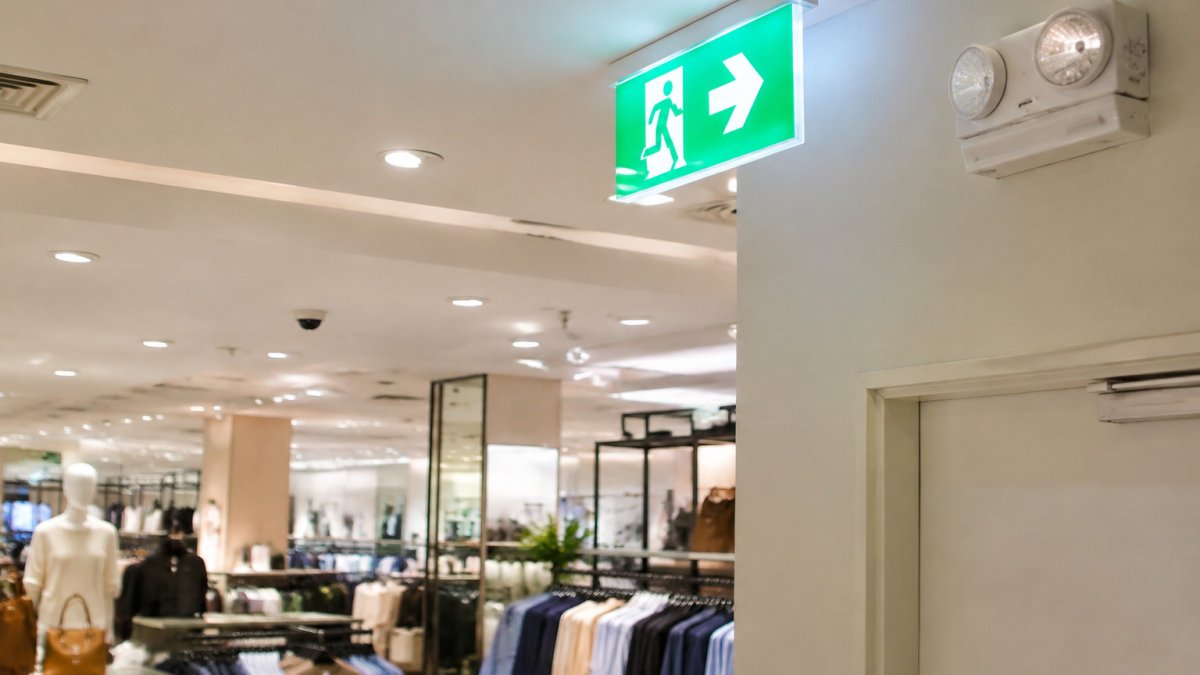
Exit signs are needed over each exit door and at points where the exit route changes direction. A sign that is blocked by shelving or stock fails the inspection just as a missing sign does.
Applying the rules to a retail floor plan
Generic guides stop at the list above. The practical work is mapping it onto a shop layout, because retail floor plans change far more often than office ones. A workable method is to trace each exit route from the furthest point a customer can stand back to the final exit door, then check that every point on that path has either an emergency luminaire or an exit sign visible from it.
- Aisles: the route between the furthest aisle and the exit needs illumination at floor level, not just at the ends. Tall gondola shelving can shadow a luminaire that looked adequate on the plan.
- Checkout zones: queues push customers into spaces that were not designed as circulation. If a checkout row sits across an exit path, the path still needs lighting and the exit sign must remain visible above the queue.
- Stockrooms and back-of-house: staff routes to the rear exit are often the least lit and the most cluttered. These count as exit routes and are commonly where inspectors find gaps.
- Leased fit-outs: where a tenant takes an existing shell, the base-building emergency lighting may stop at the tenancy boundary. The fit-out usually has to extend coverage into the tenancy, and the lease may not make that clear.
Watch out: promotional banners, end-of-aisle displays and seasonal stock are the most common cause of a sign or luminaire being obscured between inspections, and the obstruction is rarely noticed by the staff who installed it.
If you are unsure whether an area counts, treat it as part of the exit route until a qualified assessor confirms otherwise.
Emergency Lighting Duration Requirements Under AS/NZS 2293
Duration is where many retail sites fall short. Lights that flicker on for a few minutes after a blackout do not meet the standard.
Emergency lighting duration requirements depend on the building and the applicable standard, so check the requirement that applies to your building before relying on any specific figure.
Battery condition decides whether the 90 minutes is real. Batteries lose capacity with age and heat, so a unit that passed last year may fail now. This is why the testing cycle matters as much as the original installation.
Watch out: a discharge test that only checks the lights come on will miss a failing battery. The test has to run the full duration.
The article sets out the key testing and duration points for emergency lighting in one place.
| Requirement | Frequency or period | Note |
|---|---|---|
| Functional check | Six-monthly | Short operation test, not a full discharge |
| Full duration test | Annual | Normally a 90-minute discharge test |
| Minimum duration | 90 minutes | Battery condition decides whether this is real |
| Monthly visual check | Monthly | Confirm signs lit and routes unobstructed |
Emergency Exit Sign Requirements for Retail Premises
Exit signs must be easy to read in smoke or low light. The standard sets requirements for sign size, lettering, illumination and mounting height. Signs must be illuminated at all times, and an exit sign that is dim or flickering must be repaired or replaced.
Placement matters as much as the sign itself. Signs should face the direction of travel, and they must not be hidden by stock, displays or decorations. Retail managers often move shelving or add promotional banners, and these changes can block a sign without anyone noticing. Walk the exit routes after every fit-out or stock change.
Emergency Lighting Testing Requirements: Six-Monthly and Annual
Testing is what keeps the system compliant between inspections, and it is the area where retail sites most often fall down on documentation rather than hardware. In general, emergency lighting needs:
- Six-monthly tests: A functional check to confirm each luminaire and exit sign operates and the battery responds. This is a short operation test, not a full discharge.
- Annual tests: A full duration test, normally a 90-minute discharge test, to confirm the battery still holds its charge.
What each test actually involves
The six-monthly test is a functional check of each unit and exit sign. The annual test runs the system on battery for the full rated duration and records whether every unit stayed lit for the whole period. Units that fail to maintain illumination for the required duration often indicate aging power cells, necessitating a timely battery replacement guide to ensure ongoing compliance.
Battery condition decides whether the rated duration is real. Batteries lose capacity with age and heat, so a unit that passed last year may fail now. This is why the testing cycle matters as much as the original installation.
Watch out: a discharge test that only checks the lights come on will miss a failing battery. The test has to run the full duration, and the result has to be written down unit by unit.
Who can carry out the testing
The rules on who may carry out testing and how the logbook must be kept are set out in the standard and in state and territory regulations. In practice, the person doing the test needs to be competent to operate the system, recognise a failed unit and record the result accurately. Check what your state or territory regulator expects before relying on in-house staff for testing.
Record keeping and the logbook
Every test must be recorded in a logbook kept on site. A record that survives an audit normally shows, for each test:
- The date of the test and the name of the person who carried it out
- The units and exit signs checked, identified by location
- The result of each check, including any unit that failed
- The fault found, the action taken and the date it was rectified
- The date of the next scheduled test
Auditors ask for this logbook first, so an incomplete record can cause problems even when the equipment is working. A logbook that lists only a date and a signature, with no unit-level results, is the most common documentation gap found on retail sites.
Keep the logbook with the monthly visual checklist so the two records tell a continuous story between formal tests.
Emergency Lighting Inspection Checklist for Store Managers
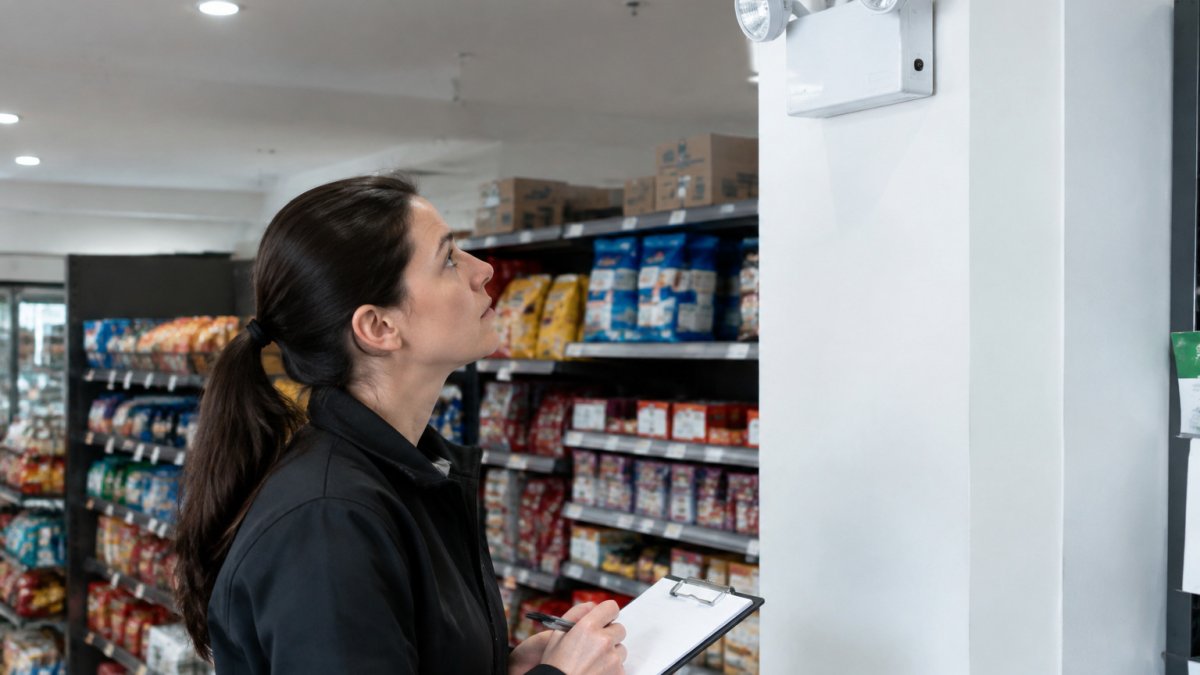
A store manager does not need to carry out the formal tests, but a regular visual check catches problems early. Use this checklist every month:
- Every exit sign is lit and readable
- No stock, shelving or displays block any sign or luminaire
- Exit routes are clear and lit when you test the mains supply
- Test buttons on the units are working, if fitted
- No luminaire shows a fault indicator or damaged housing
- Last six-monthly and annual test dates are recorded in the logbook
- Any fault has been reported to the maintenance provider and logged
Keep a copy of this checklist with the logbook. A dated record of monthly checks shows that the site is being managed between formal tests.
Booking a Compliance Check for Your Gold Coast Store
If your store is on the Gold Coast and you are not sure your emergency lighting meets current requirements, a professional compliance check is the fastest way to find out. Fyrepower provides fire safety equipment, installation and professional testing services for commercial premises.
Fyrepower is a fire protection specialist serving the Gold Coast region and is fully insured. Our team provides professional testing services for fire safety equipment.
Get in touch with us now!
Frequently Asked Questions
Do all retail shops need emergency lighting?
Most retail premises that are used by the public or employees need emergency lighting in the areas that form part of an evacuation route. Very small shops may fall outside some requirements depending on building class and occupancy, so confirm your obligations with a qualified fire safety professional before assuming an exemption applies to your store.
How often must emergency lighting be tested in Australia?
Emergency lighting should be tested according to the applicable standard and the requirements of the relevant regulator. Each test should confirm that luminaires activate on power failure, provide adequate illumination along the exit path, and remain lit for the required period. Keep a maintenance logbook recording the date, the result of each test and the name of the competent person who carried it out.
How long must emergency lighting operate during a power failure?
Emergency lighting must remain illuminated for the period set by the applicable standard after a mains power failure. Battery capacity is checked during the annual duration test to confirm the 90-minute performance is still achieved.
Who is responsible for maintaining emergency lighting in a retail building?
Responsibility usually sits with the building owner or the person who has management control of the premises, which is often the landlord or body corporate for a shopping centre. Tenants who operate a shop still have duties under workplace health and safety laws to ensure their premises are safe. Agree in writing who will arrange testing and maintenance, and keep records so both parties can demonstrate compliance.